
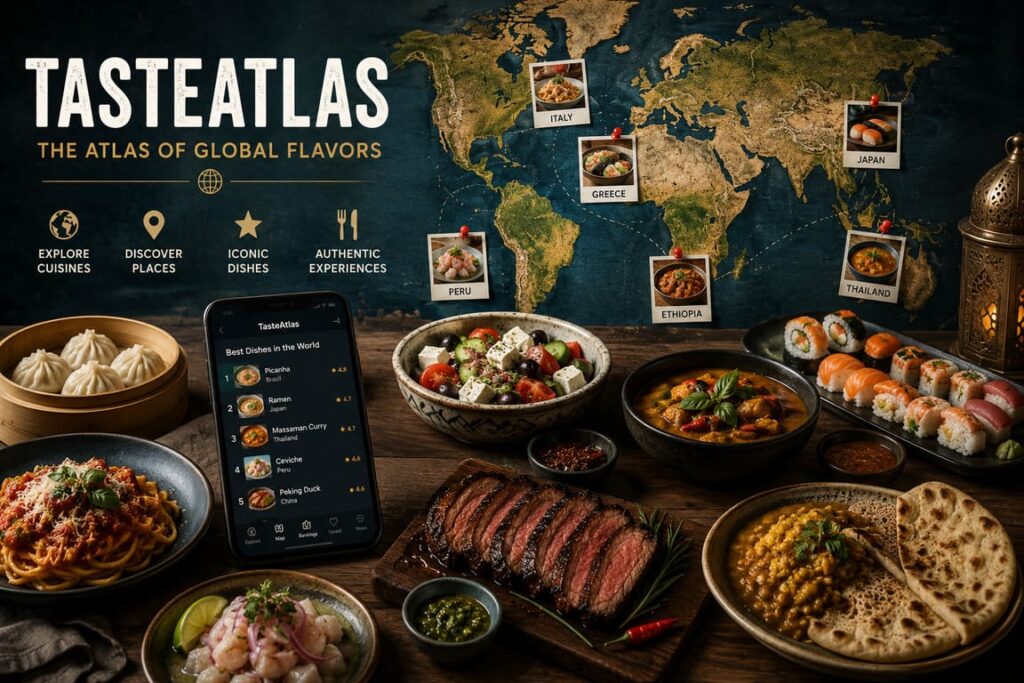

Any digital product that can trigger national pride, restaurant envy, travel inspiration, and online arguments from a single infographic has found something close to product-market fit. TasteAtlas is one of those products. At first glance, it looks like a stylish guide to traditional dishes and authentic restaurants. In practice, it operates more like a hybrid of cultural encyclopedia, search-optimized media brand, travel-discovery engine, and controversy machine. That last part is not an accident. The same design choices that make TasteAtlas memorable—rankings, maps, best-of lists, national cuisine scorecards, visual density, and “most iconic” recommendations—also make it uniquely shareable and uniquely debatable.
This matters because TasteAtlas sits in a very specific gap in the food-tech market. It is not Tripadvisor, which is strong on mass user reviews and tourist utility. It is not the Michelin Guide, which is powerful but elite and restaurant-centric. And it is not purely editorial food media like Eater or Atlas Obscura’s Gastro Obscura. TasteAtlas tries to be all of the following at once: a map of culinary heritage, a searchable dish database, a restaurant recommendation layer, and a scoreboard for world food culture. That ambition is exactly why the platform is fascinating—and exactly why people keep fighting about it.
Quick snapshot
| Metric | What stands out |
|---|---|
| Founded | 2015 |
| Public launch | Late 2018 after more than three years of R&D |
| Founder | Matija Babić |
| Headquarters | Zagreb, Croatia |
| Core concept | Encyclopedia of flavors / atlas of traditional dishes, ingredients, and authentic restaurants |
| Scale claim on homepage | 12,186 traditional dishes, 7,583 local ingredients, 20,931 authentic restaurants |
| Recognition | 2018 Awwwards honorable mention |
| Current traffic signal | Similarweb category rank #97 in Food & Drink – Other, global rank #35,591 in April 2026 |
| Traffic pattern | Heavy reliance on organic search; Similarweb shows 79.01% organic search |
| Estimated visit behavior | Similarweb shows 1:36 average visit duration |
Sources: Wikipedia
The real product is not the database. It is the framing.
The most important thing to understand about TasteAtlas is that the database alone is not the moat. A database of dishes can be copied. A global map of ingredients can be copied. Even restaurant lists can be copied. TasteAtlas’s real advantage is editorial framing. It takes messy cultural food data and packages it into strong product units: “best dishes,” “best cuisines,” “food cities,” “iconic restaurants,” “authentic recipes,” and tightly structured destination pages. That makes the platform both search-friendly and socially contagious. A dish page is useful. A ranking of the 100 best dishes in the world is useful and shareable.
That is why TasteAtlas punches above its size. Similarweb’s April 2026 snapshot suggests a modest but meaningful digital footprint compared with global consumer giants, yet the brand’s cultural visibility is disproportionately large. Why? Because TasteAtlas is built around content shapes that travel well: lists, maps, images, scores, national comparisons, and arguments. In media terms, it behaves less like a utility app and more like a high-performance content engine.
A different kind of authority
TasteAtlas was founded by Croatian journalist and entrepreneur Matija Babić in 2015 and launched in late 2018 after a long development phase. According to Wikipedia, the site began in MVP form with about 5,000 dishes in early 2018, earned an honorable mention from Awwwards in 2018, and later became a recommended curriculum resource in places including Ireland and Kansas. Those details matter because they reveal the platform’s unusual blend of journalism, design, educational ambition, and digital-product thinking.
The authority model is also unusual. TasteAtlas does not present itself as a pure user-review destination in the Tripadvisor mold. At the same time, it is not purely top-down like Michelin. NDTV describes the founder’s stated ambition as a middle ground: more rooted in traditional, everyday food culture than Michelin, but more curated and authenticity-focused than mass-tourist review platforms. Meanwhile, ratings and rankings are still fed by user scoring, which TasteAtlas says it filters using AI and behavior analysis to identify “real” users and discount spam, bots, or overtly nationalistic voting patterns.
That hybrid model is the heart of both the product’s appeal and its credibility problem. Editorial curation plus crowd ratings can be powerful. It can also be frustratingly opaque if the public cannot see clearly where human expertise ends and algorithmic filtering begins.
What the product does well
TasteAtlas is strongest when it is treated as a culinary discovery system, not a final judge of taste. The pages are structured around dishes, ingredients, preparations, regions, and iconic places to eat. Even its ranking pages tend to provide connective tissue—what a dish is, where it comes from, what it is made of, and where to find notable versions. This is especially valuable for travelers, culturally curious eaters, food writers, and hospitality professionals who want quick orientation without falling straight into generic “top 10 restaurants near me” tourism.
The design also favors long-tail food knowledge. Mainstream travel apps tend to overweight cities, hotels, and tourist-heavy restaurants. TasteAtlas overweights culinary identity. That means it can surface foods, ingredients, and regional specialties that would never dominate a general-purpose travel platform. For people who want to understand food as heritage rather than simply consumption, that is a real differentiator.
Product pillars
| Pillar | What TasteAtlas offers | Why it works |
|---|---|---|
| Cultural encyclopedia | Dish, ingredient, and regional pages | Gives context and makes the platform educational |
| Rankings engine | Best dishes, cuisines, cities, regions, restaurants, cookbooks | Drives virality, repeat visits, and social discussion |
| Travel utility | “Most iconic” places and authentic restaurant references | Helps users convert curiosity into real-world eating |
| Search/media engine | Highly structured pages and list formats | Performs well in search and on social media |
| Visual storytelling | Photo-forward design and infographic-style outputs | Makes food legible at a glance and easy to share |
Where it becomes controversial
TasteAtlas’s most visible weakness is not that it ranks food. It is that ranking food at global scale creates unavoidable methodological and cultural problems. NDTV’s analysis spells this out clearly: cuisines are too diverse, too local, and too emotionally charged to collapse neatly into global numeric hierarchies. The article points to criticism around oversimplification, unequal comparisons, unclear authority, and results that sometimes feel strange or tone-deaf to people inside the cultures being ranked.
The controversies are not hypothetical. In 2022, backlash followed TasteAtlas’s cuisine rankings after Malaysia placed low and European cuisines dominated the top tier. The company responded by explaining that a country’s score comes from the average user rating of the 30 best dishes, beverages, and food products in that country, and that AI is used to validate whether raters appear genuine rather than biased or bot-like. In 2024, Indian users reacted sharply to lists of “worst-rated” Indian foods, arguing that the platform’s audience and scoring system misunderstood local taste and culinary context.
This is the platform’s central tension: TasteAtlas has built a product that is excellent at making food conversation visible, but less convincing at making those conversations feel fully settled or universally legitimate.
Methodology: useful, but not transparent enough
TasteAtlas’s methodology has some clear strengths. The company says it filters ratings with AI, rejects manipulative behavior, and avoids counting simplistic nationalist voting. That is much better than a naïve open-vote system. It also explicitly acknowledges that if there is not enough trustworthy information, some items are not included. Those are good signals.
But the platform still falls short on explainability. Users can understand that filtering exists without understanding how it works in meaningful detail. For a site whose rankings often go viral as semi-authoritative truth, that gap matters. If TasteAtlas wants to be taken seriously not only as shareable food media but as a trusted cultural database, it needs to publish more auditable methodology, clearer weighting logic, and better context around regional variation and category design.
Numbers that show both promise and limits
One current ranking page says the “100 Best Dishes in the World” list is based on 367,847 valid ratings for 11,258 dishes in the database. That is a substantial signal base, and far beyond hobby-project scale. The homepage search snippet also advertises a catalog of 12,186 traditional dishes, 7,583 local ingredients, and 20,931 authentic restaurants, which together frame TasteAtlas as a serious content asset rather than a lightweight blog.
At the same time, Similarweb shows a profile that looks much more like a focused niche media property than a dominant global travel platform: category rank #97 in Food & Drink – Other, global rank #35,591, average visit duration 1:36, and traffic heavily led by organic search (79.01%). That is not bad. In fact, it may be exactly the right shape for a high-intent discovery brand. But it also suggests that TasteAtlas’s influence comes more from attention efficiency than from sheer scale.
Competitor comparison
| Platform | Core strength | Where TasteAtlas wins | Where TasteAtlas loses |
|---|---|---|---|
| Tripadvisor | Massive review volume and tourist utility | Better traditional-food framing, stronger dish-level identity | Weaker everyday booking/review utility |
| Michelin Guide | Prestige and restaurant authority | Broader coverage of everyday food culture | Less elite credibility and less chef-world status |
| Atlas Obscura / Gastro Obscura | Storytelling and cultural curiosity | More structured food taxonomy and searchable dish pages | Less editorial depth and narrative richness |
| Yelp / Google Maps | Local utility and immediacy | Better cultural context and destination-food inspiration | Poorer real-time local decision support |
| Food media (Eater, CN Traveler food sections) | Editorial voice and criticism | Better database structure and evergreen discoverability | Less original reporting and less criticism depth |
This table is a strategic product-positioning analysis based on platform roles.
Business model: more media-tech than pure travel tech
TasteAtlas looks like a travel platform, but its economic logic feels closer to search-driven media with a structured database advantage. Similarweb shows advertising and analytics signals, heavy organic-search dependence, and a pattern consistent with content-led acquisition. In plain English: TasteAtlas appears to monetize attention, discoverability, and brand value more like a digital media property than like a restaurant reservation network.
That is not a flaw. It may actually be the right model. Traditional food is an editorially rich subject with global search demand, endless localization opportunities, and high emotional engagement. The risk is that media incentives can over-reward rankings and controversy while under-investing in methodological transparency and on-the-ground verification.
Strengths and weaknesses
Pros
- Clear positioning around traditional food, not generic dining.
- Beautifully structured content that is easy to search and share.
- Strong long-tail value for regional dishes and ingredients.
- Excellent virality mechanics through rankings and maps.
- Useful middle ground between elite guides and chaotic user-review platforms.
Cons
- Methodology opacity remains the platform’s biggest credibility drag.
- Rankings can flatten cultural nuance into simplistic scoreboards.
- Audience bias is hard to fully eliminate, even with AI filtering.
- Restaurant utility is weaker than platforms built for immediate local decisions.
- Traffic dependence on organic search can become a strategic vulnerability if discovery channels change.
Interesting facts
- TasteAtlas spent more than three years in research and development before its late-2018 launch.
- Wikipedia says the project was still in MVP stage in early 2018 with around 5,000 dishes.
- A 2022 report said the company had a team of about 30 authors and researchers, with 10,000+ foods and drinks and around 9,000 restaurants catalogued at that time.
- One current TasteAtlas ranking page says its top dishes list is based on 367,847 valid ratings for 11,258 dishes.
- The site received an Awwwards honorable mention in 2018, a reminder that design mattered to the project from the start.
Who should use TasteAtlas?
Best for
- Travelers who care about local specialties, not just famous restaurants.
- Food writers and researchers who need a quick global orientation layer.
- Curious eaters building destination wish lists.
- Hospitality teams looking for a snapshot of how dishes are framed internationally.
- Teachers or culture-focused educators using food as an entry point into geography and identity.
Less ideal for
- People who need real-time restaurant logistics, reservations, or hyper-local review volume.
- Users who treat online rankings as definitive truth rather than conversation starters.
- Professionals seeking transparent, fully auditable culinary methodology.
FAQ
1. Is TasteAtlas reliable?
It is reliable as a discovery and orientation tool, but less reliable as a final, unquestionable authority on “the best” anything. Its structured content is useful; its rankings are best read with skepticism and context.
2. How is it different from Tripadvisor?
Tripadvisor is mainly about large-scale user reviews and tourist decision-making. TasteAtlas is more focused on traditional dishes, regional food identity, and editorially framed discovery.
3. Why does it cause so many arguments?
Because food is culturally loaded, and TasteAtlas packages it into rankings that invite comparison, pride, and backlash. That is built into the product.
4. Is TasteAtlas more like Michelin or more like social media?
It is somewhere in between: more curated and heritage-focused than ordinary review sites, but far more crowd-shaped and internet-native than Michelin.
5. What is TasteAtlas’s biggest long-term opportunity?
Becoming the default structured knowledge layer for global traditional food—not just a viral ranking brand.
Final verdict
TasteAtlas is one of the smartest food products on the internet because it understands that discovery is emotional, cultural, visual, and competitive all at once. It succeeds brilliantly as a gateway to culinary curiosity. It succeeds commercially because it turns cultural heritage into searchable, rankable, shareable product units. It falls short when it asks users to accept those same rankings as neutral or fully authoritative.
In other words, TasteAtlas is best understood not as a culinary court of final appeal, but as a remarkably effective interface for global food conversation. Used that way, it is excellent. Used as a final scoreboard for civilization, it is much shakier.