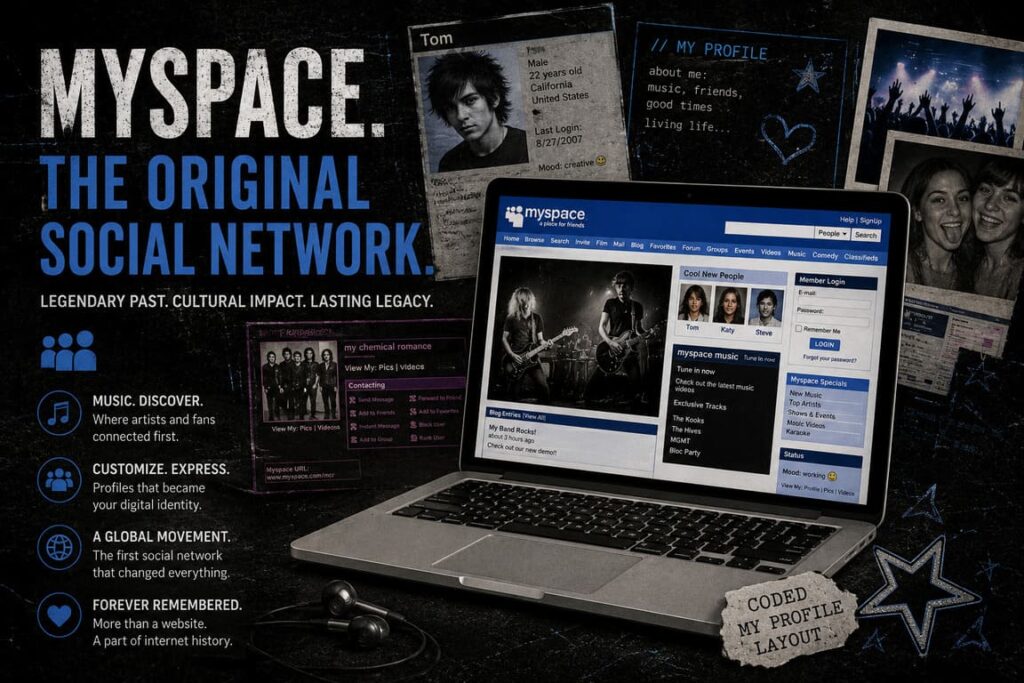

It is impossible to review Myspace without separating two different things: the legend and the current website. The legend is huge. Myspace was one of the defining internet platforms of the 2000s and, according to Wikipedia, the first social network to reach a truly global audience. From 2005 to 2009, it was the largest social networking site in the world. At its peak in April 2008, it had 115 million monthly visitors, and by 2009 it had passed 300 million registered users. That kind of cultural weight still matters because it shapes how people react when they type the domain today.
The current website, however, tells a very different story. Today’s Myspace homepage looks less like a living social network and more like a music-and-entertainment property with editorial posts, artist-related content, sign-in prompts, and a strong nostalgia halo. A crawl of the homepage shows article categories like News, Artist of the Day, Playlist, Premiere, and Gallery, plus music and artist-related headlines. It still carries a cultural tone, but it no longer feels like the center of online identity the way it once did.
That gap between past and present is the whole point of the Myspace review. If you judge it only by history, it is one of the most important social sites ever made. If you judge it only by the current user experience, it feels fragmented, dated, and oddly suspended between legacy brand and active media platform.
The rise of Myspace still matters
One reason Myspace remains so interesting is that it helped define early social media culture before today’s polished, app-first platforms took over. Wikipedia notes that it launched in 2003 and quickly became the dominant social network. It was famous for music discovery, customizable profiles, direct fan-to-artist contact, and a more chaotic, personal feeling than later platforms. That legacy still gives the brand emotional value, especially for people who grew up with it. Source
The ownership history also says a lot about the company’s path. Wikipedia summarizes a long chain of changes: News Corporation bought Myspace in 2005 for $580 million; Specific Media acquired it in 2011, with Justin Timberlake involved publicly in the relaunch era; Time Inc. later bought Viant, the parent company tied to Myspace, in 2016; and the asset later ended up back under Viant Technology ownership after corporate reshuffling. Myspace’s own current policies identify the service as owned by the digital media company Viant Technology.
That matters because modern Myspace is not really an isolated platform. It sits inside a larger corporate context tied to ad-tech and media infrastructure. The site’s privacy policy says Myspace currently does not serve ads directly to users inside the Myspace service, but it does share personal information with its corporate affiliate Viant, which may in turn share it with third parties, including advertisers. That is a very important fact if you want to understand how the current business model differs from the old social-network image many people still have in mind.
What the website feels like today
The current homepage is an unusual mix. On one hand, it still has sign-in and join prompts, which suggest a social platform. On the other hand, the main content surfaced by the crawler is heavily editorial: music news, entertainment headlines, artist features, and image-led stories. You can still see traces of the old artist-first identity, but the site no longer feels like the place where internet culture is being made in real time. It feels more like a branded entertainment front end with legacy account infrastructure still attached.
Its own terms describe Myspace as a place where people come to connect, discover, and share, with roots in music and social. The terms also say the platform showcases artists and their work, gives access to a large digital music library, and includes music, video, mobile, developer, and advertising services. In theory, that sounds broad and alive. In practice, the public-facing experience feels much thinner than that description suggests.
That mismatch is one of the strangest things about modern Myspace. The legal and policy documents still describe a fairly rich platform. The historical record describes a giant. The homepage shows a functioning entertainment site. But the brand identity remains stuck between past promise and present limitation. That does not make it useless. It makes it hard to define.
Quick facts about Myspace
| Item | Details |
|---|---|
| Launch year | 2003 |
| Original importance | First social network to reach a global audience |
| Peak period | Largest social network from 2005 to 2009 |
| Peak traffic cited by Wikipedia | 115 million monthly visitors in April 2008 |
| Peak scale cited by Wikipedia | More than 300 million registered users by 2009 |
| Historic strength | Social networking + music discovery + artist pages |
| Current public feel | Editorial music/entertainment site with legacy social features |
| Current corporate context | Myspace policies say it is owned by Viant Technology |
| Current data model | No direct ads in service, but data may be shared with affiliate Viant |
What Myspace still does well
The best thing Myspace still has is identity. Even in a reduced state, the brand means something. It still carries weight in music culture, internet history, and digital nostalgia. That gives the site a kind of built-in relevance that many dead platforms do not have. People still click because the name still matters
The second thing it does reasonably well is editorial framing. The homepage still surfaces entertainment and music-related stories in a magazine-like format, with categories and article tiles that feel easy to browse. If you arrive as a casual reader instead of as someone expecting a full social network, the site makes more sense.
The third positive is that Myspace still maintains a clear artist-and-creative language in its official terms. It says the platform is built to empower artists, including musicians, designers, writers, and photographers, and to help them connect with audiences and collaborators. Even if the execution feels much smaller than the old dream, the mission is at least coherent. Source
A few interesting facts about Myspace
- It was once the biggest social network in the world, before Facebook overtook it in 2009.
- Its current policies still describe a music library, artist tools, and multiple service layers, even though the public site feels far leaner than that description.
- The privacy policy says Myspace currently does not show ads inside the service, yet still shares data with affiliate Viant for advertising-related purposes.
- The terms warn users to back up uploaded data because Myspace is not responsible for the ongoing integrity, accessibility, or usability of uploaded files. That is a striking line for a platform with such a long history of music and profile content.
Where Myspace falls short
The biggest problem is obvious: it no longer feels essential. A site with Myspace’s history should either be a strong modern niche platform or a carefully preserved archive experience. Right now, it sits awkwardly in the middle. It is not dead, but it is not culturally central. It is not a clean archive, but it is no longer a true social powerhouse either.
Another issue is trust and clarity. The privacy policy is very explicit that Myspace is aimed at a U.S. audience, hosted in the United States, and connected to broader data-sharing practices through Viant. For users who care about privacy, that matters. So does the policy’s statement that user media consumption may be tracked and used under consent-based rules. This is not unusual for internet services, but it is especially notable on a platform many people may remember through a much older mental model.
The terms also contain a long list of hard limitations that make the site feel more defensive than dynamic. Myspace may terminate services at any time, remove content, reassign usernames, and offers the service “as is.” It also states that uploaded files should be backed up by users because ongoing access is not guaranteed. That is practical legal language, but it also reinforces the sense that this is a legacy platform operating with caution rather than a growing product full of confidence.
Table 2: Strengths and weaknesses of the current Myspace experience
| Area | What still works | What feels weak |
|---|---|---|
| Brand value | Strong nostalgia and cultural recognition | Legacy reputation is much stronger than present product power |
| Content focus | Music and entertainment editorial is still easy to browse | Social features no longer feel central |
| Artist identity | Official language still supports creators and artists | Public experience feels smaller than the mission statement |
| Business model clarity | Privacy policy explains current data-sharing setup | That setup may surprise users expecting a simple media site |
| User trust | Long history and famous name attract attention | “As is” terms and backup warnings reduce confidence |
| Product direction | Still active enough to browse | Hard to tell whether it is a media brand, artist platform, or social relic |
Final verdict
Myspace is still historically important, but it is no longer important in the way it once was. Today, the site works better if you think of it as a legacy music-and-entertainment property with social leftovers, not as a real competitor to modern social platforms. That framing makes the current experience easier to understand and fairer to judge.
As a brand, Myspace remains iconic. As a current website, it is functional but limited, recognizable but reduced, active but no longer central. For someone visiting out of nostalgia, there is still something interesting there. For someone looking for a serious modern social home, the site feels like a reminder of what used to be possible rather than a model of what comes next.
That does not erase its legacy. If anything, the current state makes the legacy stand out even more. Myspace is now most powerful as a symbol: a reminder that internet giants can shape culture, lose the lead, change owners, and survive as something smaller but still strangely memorable
FAQ about Myspace
What is Myspace today?
Today it looks more like a music-and-entertainment site with legacy social features than a dominant modern social network.
Why is Myspace historically important?
Because it was the first social network to reach a global audience and was the largest social networking site from 2005 to 2009.
Who owns Myspace now?
Myspace’s own policies state that the service is owned by the digital media company Viant Technology.
Does Myspace show ads directly on the service?
Its privacy policy says that, at this time, Myspace does not serve advertisements directly to users as part of the Myspace services.
Does Myspace still focus on artists and music?
Yes. Its terms still describe it as a place built to showcase artists and help them connect with audiences and collaborators.
What is the biggest weakness of current Myspace?
The current site feels caught between old social-network identity and a narrower present-day media role, so its purpose is less clear than it used to be.