
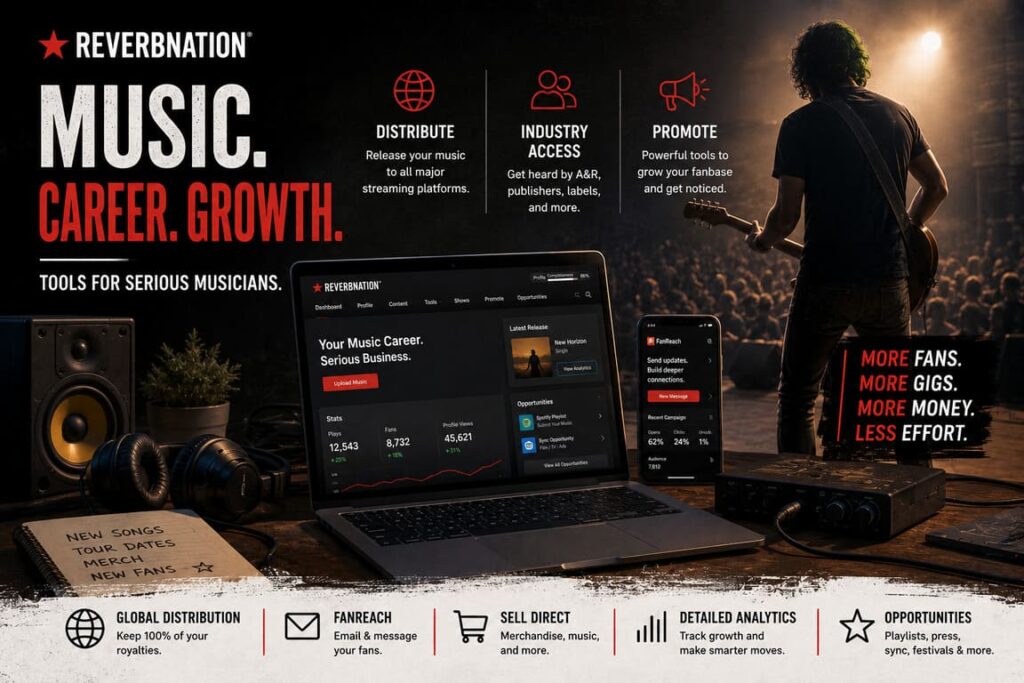

If you want the short version first, ReverbNation is a practical music platform built for independent artists who care less about hype and more about actually moving a career forward. Its message is very clear: distribution, industry access, and promotion tools. That focus makes the website feel more business-minded than many artist platforms that are mostly about profiles and vanity metrics. ReverbNation is not trying to be a social app for everyone. It is trying to be a working toolbox for musicians.
That identity matters because the company has been around for a long time. Wikipedia says ReverbNation launched in 2006, focuses on the independent music industry, and remains active. It was acquired by BandLab Technologies in 2021, and ReverbNation’s own terms now state that the site and its related services are owned and operated by BandLab Singapore Pte. Ltd. So this is not a forgotten indie startup drifting on momentum. It is an established platform with a clear owner and a long track record in artist services.
What ReverbNation is actually built to do
The homepage says your music career is “serious business,” and that one line sums up the product well. ReverbNation is centered on three core promises: music distribution, industry access, and promo tools. It positions itself as a dependable way to get music onto major streaming platforms, place songs on social video apps, keep 100% of royalties or earnings depending on the page, and connect artists to A&R, publishing, sync, playlists, press, and other opportunities.
That is the good kind of focused. Instead of trying to do everything for every kind of creator, ReverbNation sticks to the workflow that matters for working musicians: release music, promote it, grow an audience, look professional, and find openings in the industry. The platform also highlights tools like FanReach for emailing and messaging fans, direct-to-fan sales features, artist profiles, websites, press kits, and promotional services. Taken together, that makes ReverbNation feel more like a career support system than a simple upload destination.
Why the website still feels relevant
The most impressive thing about ReverbNation is that it has not lost its purpose. Many older music platforms either fade into nostalgia or try to reinvent themselves into something vague. ReverbNation has stayed readable. It still talks directly to independent artists who need practical help. The homepage highlights “more fans, more gigs, more money, less effort,” and while that is marketing language, it is at least tightly aligned with the actual tools being sold. Source
Its blog reinforces that same direction. The current editorial focus includes music distribution checklists, ad copy for music promotion, fan growth, Spotify playlists, TikTok, live show strategy, merch sales, and broader industry news. That tells you the audience is not casual listeners. It is musicians trying to make smarter business decisions. The blog is basically an artist-development companion to the core product.
Table 1: Quick facts about ReverbNation
| Item | Details |
|---|---|
| Website type | Music industry / artist services / social networking website |
| Launch year | 2006 |
| Current status | Active |
| Current owner | BandLab Technologies / BandLab Singapore Pte. Ltd. |
| Main audience | Independent musicians and career-minded artists |
| Core promises on homepage | Music distribution, industry access, promo tools |
| Key promotional tool | FanReach |
| Current positioning | Artist-first platform focused on growth, opportunities, and music releases |
What ReverbNation does well
The first major strength is clarity. A lot of artist platforms make users hunt around to understand what they are paying for. ReverbNation does not. The homepage and distribution pages tell you exactly what the platform thinks matters: global distribution, support, career tools, industry opportunities, and promo workflows. Even if you decide it is not for you, the product is honest about its priorities.
The second strength is that ReverbNation is trying to support the whole release cycle, not just the upload moment. The distribution page talks about release setup, cover art, support, reporting, built-in marketing tools, opportunities for promotion, direct-to-fan sales tools, communication with fans, and artist-development resources. That broader view is useful because independent artists usually struggle after release day, not before it. ReverbNation seems to understand that problem.
The third strength is industry access. The site repeatedly emphasizes opportunities, A&R, publishing, sync, festivals, playlists, and press. Now, that does not mean every artist will get meaningful results. No platform can promise that. But this is still one of ReverbNation’s strongest differentiators. It is not only saying “put your music online.” It is saying “we might help you get it in front of decision-makers.” That is a more ambitious offer, and it helps explain why the company still has a place in the independent music market.
The fourth strength is support positioning. ReverbNation says it answers every email within 24 hours, often faster. For artists dealing with release schedules, metadata issues, or distribution questions, that promise matters. Many music platforms are decent when everything works and frustrating when something breaks. ReverbNation is clearly trying to use support responsiveness as a selling point.
A few interesting facts about ReverbNation
One interesting historical detail is that ReverbNation was early in using widgets and portable music tools. Wikipedia notes that its TuneWidget helped artists place content on web pages and link listeners back to more music and related material. In the late 2000s, that kind of portability mattered a lot more than it does now, and it shows that ReverbNation was built around artist distribution and discovery from the start.
Another interesting feature from its earlier history is “Band Equity,” a metric that measured popularity using reach, influence, access, and recency. Whether or not that system was perfect, it shows the company was thinking early about artist analytics and visibility in more complex ways than simple play counts
A third notable point is that established artists have used the platform or appeared in its marketing history. The current homepage lists names such as Mac Miller, Imagine Dragons, Charlie Puth, Alabama Shakes, Bryson Tiller, AWOLNation, and Florida Georgia Line, among others. That does not mean ReverbNation created those careers by itself, but it does show the brand has touched artists who later became widely known
A fourth point is its publishing angle. The distribution page says ReverbNation offers publishing access through an exclusive partnership with Warner Chappell Music for qualifying artists and songwriters, including global publishing royalty collection and access to Warner’s creator and sync teams. That is a serious value proposition for writers who are thinking beyond streaming revenue alone.
7 reasons an independent artist might still choose ReverbNation
- It combines music distribution with promotional tools in one place.
- It is built around career growth, not just track hosting.
- It offers access to opportunities like playlists, festivals, press, A&R, and sync.
- FanReach gives artists a direct way to message fans through email and social channels.
- The blog and resources are aimed at practical artist development.
- The site has been around long enough to feel established rather than experimental.
- It now sits under the larger BandLab umbrella, which adds stability and strategic relevance. Source
Where ReverbNation feels limited
Its biggest weakness is that the platform can feel a little old-school in tone and structure. That is not always bad. In fact, some artists may prefer it because it feels more direct and less trendy. But compared with newer creator platforms, the site is less sleek and less lifestyle-driven. ReverbNation feels like a workbench, not a shiny consumer app. That is good for clarity, but it may feel less exciting to artists who want a more modern, social-first experience.
Another limitation is product sprawl. ReverbNation offers free access, paid subscriptions, one-off distribution packages, promotional tools, sponsored artist options, websites, embeds, email marketing, and more. The good side is flexibility. The downside is that new users may need a little time to figure out which path fits them best. A pure distributor is simpler. ReverbNation offers more than that, but the trade-off is a bit more complexity.
A third issue is that “opportunities” are always attractive in marketing, but they are also hard to evaluate from the outside. ReverbNation emphasizes its industry relationships and dedicated A&R team, and that may absolutely be useful for some artists. But independent musicians should still approach these promises with realistic expectations. No platform can guarantee meaningful industry traction just because you upload music and subscribe. ReverbNation looks most useful when artists treat it as a support system, not a shortcut.
Current plans and notable features on ReverbNation
| Plan / Service | Listed price | What it includes |
|---|---|---|
| Free | $0/month | Artist profile, unlimited songs, sell your music, Gig Finder, email/social marketing, embedded players, Facebook app |
| Basic | $12.95/month or $129.50/year | Free features plus opportunities, electronic press kit, large song uploads, increased email contacts, ad-free profile |
| Premium | $19.95/month or $199.50/year | Basic features plus unlimited distribution, website with free domain, unbranded embeds |
| Digital Distribution | From $1.00 + tax | Entry-level release distribution options |
| Promote It | From $21.00 + tax | Paid ad/promotion tools |
| Sponsored Artists | Varies | Paid visibility on ReverbNation pages |
At the time of the current pricing page, ReverbNation also advertises two free months on Basic and Premium annual plans.
What the pricing says about the business
The pricing model is a mix of freemium subscriptions and add-on services. That is a smart fit for the audience. New artists can start free, test the platform, and then move into paid plans if they need more visibility, better presentation, or unlimited distribution. Meanwhile, the add-on tools let users spend more only when they have a specific release or campaign to promote. This is more flexible than forcing everyone into one expensive package.
The distribution page adds another layer by offering single and album packages at different platform levels, plus a Premium subscription with unlimited releases and extra artist tools. This reinforces the idea that ReverbNation is not just one product. It is a stack of services built around different stages of an artist’s career.
Final verdict
ReverbNation is not the newest name in music tech, but that is part of its value. It has history, a clear product identity, a real artist-services framework, and a practical understanding of what independent musicians need after they finish a song. It is strongest when viewed as a career utility platform: distribute music, promote it, communicate with fans, build a professional presence, and keep an eye on industry opportunities.
It is weaker as a modern “cool factor” platform. If you want the newest-looking interface or a hype-driven creator ecosystem, you may find it a bit plain. But if you want something readable, artist-focused, and grounded in the daily work of releasing and promoting music, ReverbNation still makes a strong case for itself.
The best way to describe it is simple: ReverbNation feels less like a social trend and more like a working tool. For serious independent artists, that may be exactly the point.
FAQ about ReverbNation
What is ReverbNation mainly used for?
ReverbNation is mainly used by independent artists for music distribution, fan promotion, artist profiles, and access to industry opportunities.
Who owns ReverbNation now?
ReverbNation’s terms say the site and services are owned and operated by BandLab Singapore Pte. Ltd., and Wikipedia lists BandLab Technologies as the owner after the 2021 acquisition.
Is ReverbNation only a music distributor?
No. Distribution is a big part of the platform, but it also offers promo tools, FanReach, artist websites, press kits, opportunities, and other career tools.
What is FanReach?
FanReach is ReverbNation’s built-in messaging tool for emailing and sharing updates with fans through email and social channels. It is meant for promoting songs, events, videos, and status updates while collecting fan emails.
Does ReverbNation keep artist royalties?
Its current marketing pages say artists keep 100% of their royalties or earnings, depending on the service page being viewed.
Is ReverbNation good for beginners?
Yes, especially for beginners who want an all-in-one launch point. The free tier lowers the barrier to entry, and the platform’s tools are clearly aimed at helping artists release, promote, and organize their career.
What is the biggest downside of ReverbNation?
The biggest downside is that it can feel a bit less modern or sleek than newer creator platforms, and its mix of subscriptions and add-ons may take a little time to understand.