
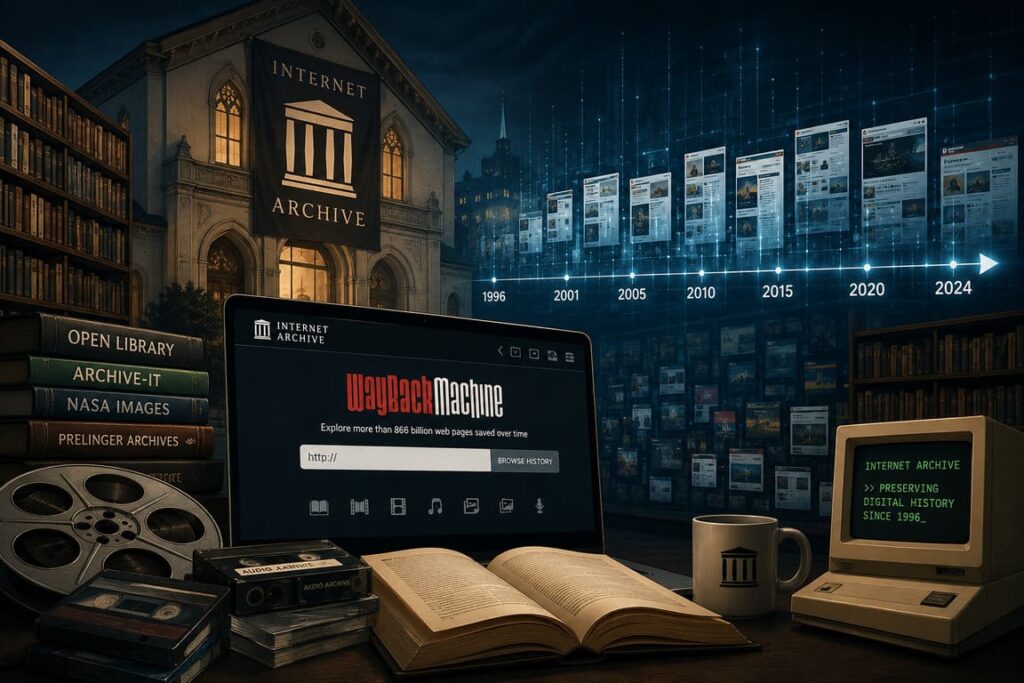

Archive.org, also known as the Internet Archive, is not just another website. It is one of the most important public-interest projects on the web. The organization was founded in 1996 by Brewster Kahle and operates as a non-profit digital library. Its mission is simple and ambitious: to provide “universal access to all knowledge.”
For many people, archive.org is best known for the Wayback Machine, a tool that lets users view older versions of websites. But that is only one part of the platform. The Internet Archive also offers access to digitized books, music, videos, software, and other historical materials. In a web that often deletes, rewrites, or hides the past, archive.org plays the role of memory keeper.
What the Website Offers
The Internet Archive describes itself as a digital library of free and borrowable texts, movies, music, and the Wayback Machine. Its services include not only web archives, but also projects such as Open Library, Archive-It, NASA Images, and the Prelinger Archives. That broad scope is one of the site’s greatest strengths. It is not focused on one media type; it tries to preserve digital culture as a whole.
The scale is massive. According to Wikipedia, the Wayback Machine contains hundreds of billions of web captures. The Internet Archive began preserving the web in 1996, and the Wayback Machine became publicly available in 2001. This means the service has recorded decades of internet history that would otherwise be gone.
Why Archive.org Matters
Most websites are built for the present moment. Archive.org is built for the future. It helps researchers, journalists, students, historians, and everyday users find materials that might disappear from the live web. That includes old webpages, outdated reports, lost software, audio collections, public domain books, and media that no longer exists in normal circulation.
This is why archive.org feels different from commercial content platforms. It is not trying to keep users scrolling for ads. It is trying to preserve access. That public mission gives the site unusual value. Even if you only use the Wayback Machine once in a while, it is hard to overstate how useful it can be when a page is deleted, changed, or quietly rewritten. Source
Interesting Facts About the Organization
Archive.org has several details that make it especially memorable. Its headquarters in San Francisco has, since late 2009, been located in a building that formerly housed a Christian Science church. That is a fitting home for a project that almost feels like a cathedral for digital preservation.
Another interesting fact is that the Archive added BitTorrent as a download option in 2012 for more than 1.3 million existing files, making large-scale distribution more practical. That move shows how the organization often thinks like an engineer as much as a library. It cares not only about keeping files, but also about how people can access them efficiently.
The platform also keeps expanding its role. Wikipedia notes a 2024 collaboration with Google that adds Wayback Machine links into Google Search’s “more about this page” experience. That matters because it brings archived web history closer to everyday search behavior.
Strengths and Weaknesses
Best reasons to use archive.org
- Historical value — it preserves websites and files that may vanish elsewhere.
- Breadth of content — books, software, video, audio, and web pages are all in one ecosystem.
- Public mission — it is a non-profit built around access, not pure monetization.
- Research usefulness — it is helpful for fact-checking, citations, academic work, and media history.
- Cultural preservation — it saves digital artifacts that commercial companies often ignore.
Main drawbacks
Archive.org is extremely useful, but it is not perfect. The interface can feel old and cluttered compared with modern commercial platforms. Search results are sometimes less clean than users expect. Also, the organization faces serious legal and copyright disputes. In 2020, major publishers sued the Internet Archive over controlled digital lending, and a court ruling in 2023 went against the Archive on part of that issue. In 2023, major music companies also sued over the Great 78 Project. These cases show that digital preservation often runs into legal conflict
So the main weakness of archive.org is not that the idea is weak. It is that preserving culture at internet scale is legally, financially, and technically difficult. That challenge is built into the project itself.
Quick Facts Table
| Category | Archive.org / Internet Archive |
|---|---|
| Website | archive.org |
| Founded | 1996 |
| Founder | Brewster Kahle |
| Organization Type | Non-profit digital library |
| Mission | Universal access to all knowledge |
| Best-Known Service | Wayback Machine |
| Other Services | Open Library, Archive-It, media archives, software collections |
| Main Use Case | Preserving and accessing digital history |
Final Verdict
Archive.org is one of the rare websites that feels bigger than a normal product review. It is not simply “good” because it works well. It is important because it protects public access to digital history. When people talk about the internet becoming more closed, more temporary, or more controlled by a few large platforms, archive.org is part of the answer.
As a website, it is not always elegant. As an institution, it is remarkable. If Tumblr represents the personal, expressive side of the web, archive.org represents the memory of the web. For researchers, curious readers, journalists, and anyone who believes knowledge should remain available, archive.org is one of the most valuable sites online.
FAQ About Archive.org
What is archive.org used for?
Archive.org is used to access archived websites, digital books, audio, video, software, and other preserved materials.
Is archive.org free?
The Internet Archive presents itself as a digital library offering free and borrowable materials, including texts, movies, music, and the Wayback Machine.
What is the Wayback Machine?
The Wayback Machine is the Internet Archive’s public web archive, launched for public use in 2001, and it contains hundreds of billions of archived web captures.
Who founded the Internet Archive?
The organization was founded by Brewster Kahle in 1996.
Why is archive.org important?
It helps preserve digital history and supports long-term public access to knowledge, media, and web content that could otherwise disappear.