
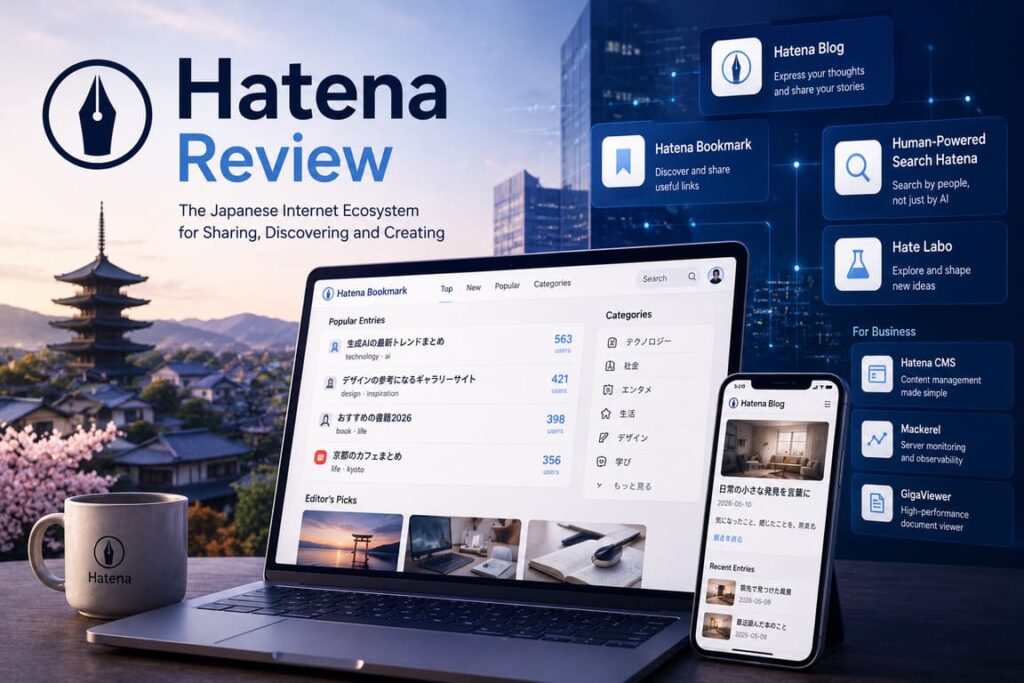

There are platforms that dominate headlines, and there are platforms that quietly shape how a country reads, writes, saves, discusses, and discovers information online. Hatena belongs firmly in the second category. To outsiders, it can look like a slightly dated Japanese portal with a social-bookmarking product attached. To people who understand the Japanese web, however, Hatena is something more interesting: a long-running user-generated-content ecosystem that evolved from quirky startup experiment into digital infrastructure. It is not just a site. It is an operating philosophy about how the internet should surface good content, reward participation, and turn collective attention into product value.
What makes Hatena worth reviewing in 2026 is not novelty. It is endurance. In an era when many Web 2.0 communities either died, pivoted into bland SaaS dashboards, or got absorbed by global giants, Hatena kept building a distinctly Japanese internet stack: blogging, bookmarking, discovery, Q&A, experimental labs, content marketing tools, observability software, manga infrastructure, and co-development work for major brands including Nintendo and publishers. That hybrid identity—consumer community on one side, enterprise-grade internet tooling on the other—is exactly why Hatena remains strategically unusual.
At a glance
| Metric | What it tells you |
|---|---|
| Founded | 2001 |
| Founder | Junya Kondo |
| Headquarters | Kyoto headquarters, Tokyo office |
| Core mission | Enrich life by helping people “know,” “connect,” and “express” |
| Main consumer brands | Hatena Blog, Hatena Bookmark, Human-Powered Search Hatena, Hate Labo |
| Main B2B/SaaS lines | Hatena CMS, Mackerel, GigaViewer, joint development |
| Public-market milestone | Listed on Tokyo Stock Exchange Mothers in 2016 |
| Recent traffic signal | ~20.3M visits in April 2026, country rank #172 in Japan according to Semrush |
| Audience concentration | 86.2% of traffic from Japan, average session duration 12:18 |
Sources: Hatena company outline
The bigger story: Hatena is not one product, it is a federation
Most reviews go wrong by treating Hatena as if it were only Hatena Bookmark. That is understandable because Bookmark is the most iconic part of the ecosystem and is still described as Japan’s best-known social bookmarking service. But Hatena’s real strategic importance comes from the way its products feed one another. The consumer side builds community habits, trust, metadata, and creator relationships; the enterprise side monetizes Hatena’s ability to run high-scale content systems, moderation-sensitive communities, developer tooling, and media infrastructure. In SaaS language, Hatena figured out a “community-to-software” flywheel long before that phrase became fashionable.
That matters because Hatena lives in a market where global internet companies are powerful but not always culturally native. Japan has long maintained its own local internet habits, language-specific communities, and media ecosystems. Hatena’s survival suggests that local product grammar still matters. Its tagging, community filtering, bookmark counts, and category-driven discovery feel less like Silicon Valley social media and more like a curated public utility for people who actually want to read the web rather than merely scroll through it.
From startup weirdness to internet infrastructure
Hatena was founded in Kyoto in 2001, moved to Tokyo in 2004, then moved its headquarters back to Kyoto in 2008. That geographic arc says something important. Hatena never fully surrendered to the default “Tokyo-first, global-copycat” startup playbook. It stayed culturally close to engineering, product craft, and community identity. Over the years it launched or experimented with services that now read like a time capsule of the social web: Hatena Diary, Hatena Bookmark, Hatena Star, Hatena Haiku, Hatena World, Flipnote Hatena, Hatena Monolith, and more. Some of those products were discontinued, but together they show a company unusually willing to prototype social formats before the market fully formed around them.
That experimentation was not a sideshow. It became capability. By the time Hatena collaborated with Nintendo on projects such as Flipnote Hatena, Miiverse, Splatoon-linked services, and Super Smash Bros. functionality, it had already spent years learning how to build communities, manage user-generated content, and sustain high-engagement products. The company’s 2017 Nintendo-related press release is revealing: Hatena explicitly frames its value as technical strength plus operational know-how earned from running large-scale consumer services such as Hatena Bookmark and Hatena Blog.
What the product experience actually feels like
Hatena’s user experience is best understood as “information-dense, community-filtered, and intentionally unglamorous.” That can sound like criticism, but it is often a virtue. Hatena Bookmark’s top page emphasizes popular entries, new entries, categories, editor-organized features, keyword search, and social pathways through other users’ bookmarks. Instead of pretending the platform can read your mind with opaque recommendation models, Hatena gives you multiple ways to navigate collective attention: by category, by tag, by popularity window, by interest word, and by people you follow.
This creates a very different emotional texture from algorithmic social feeds. Hatena feels less addictive in the modern dopamine-engine sense and more useful in the classic internet sense. You are not just watching content pass by; you are building a personal information graph. The “favorites” feature, in particular, reveals Hatena’s philosophy. It encourages users to turn other people’s bookmark behavior into a custom media layer—a human-curated feed built from trust rather than pure machine inference. That is an old-school idea, but it ages surprisingly well in a time of algorithm fatigue.
The downside is obvious: Hatena can feel visually conservative, fragmented, and intimidating to new users. Modern consumer apps optimize for immediate emotional clarity. Hatena often optimizes for depth, function, and archival usefulness. For power users, that is great. For mainstream newcomers raised on TikTok-speed onboarding, it can feel like entering a library organized by internet veterans. That is both the product’s charm and one of its biggest growth constraints.
Core ecosystem map
| Layer | Key products | Why it matters |
|---|---|---|
| Consumer publishing | Hatena Blog, former Hatena Diary | Gives creators a home base and keeps Hatena relevant in long-form expression |
| Discovery/community | Hatena Bookmark, favorites, tags, interest words | Turns bookmarking into public discovery and social filtering |
| Experimental culture | Hate Labo, legacy experiments | Preserves Hatena’s identity as an internet-native builder, not just an operator |
| Enterprise content | Hatena CMS, corporate blog plans, native advertising | Monetizes publishing know-how for businesses |
| Developer/SaaS tools | Mackerel | Extends Hatena beyond media into observability and operations |
| Platform infrastructure | GigaViewer, joint development for publishers and Nintendo | Converts years of community-tech expertise into B2B infrastructure |
Sources:
Why Hatena Bookmark still matters
Social bookmarking sounds like a relic until you look at how bad mainstream discovery has become. Search is noisier. Social feeds are more manipulative. News is more fragmented. In that context, Hatena Bookmark looks less like a relic and more like a resilient alternative model. It lets users save URLs, tag them, comment on them, and see how many other users bookmarked the same page. That count matters because it converts individual saving behavior into a public relevance signal. It is not identical to Reddit upvotes or X reposts; it is closer to a reputation layer built on what informed users deemed worth returning to.
The service also benefits from integration into the Japanese web. Wikipedia notes that major Japanese media outlets have historically included “Add to Hatena Bookmark” buttons, which gave Hatena an unusually embedded role in web circulation. That is a stronger moat than many outsiders realize. If a product becomes part of the publishing furniture of a national internet, it no longer competes only on brand awareness. It competes on habit and embedded workflow.
Business model: the smart part is the mix
Hatena’s business model is more sophisticated than its surface image suggests. Officially, the company organizes its internet business into content platform services, content marketing services, and technology solutions. That mix matters because pure consumer community businesses are notoriously hard to defend financially unless they become giant ad platforms. Hatena instead uses its consumer layer as proof of competence and as a source of operational expertise, then sells higher-value services around that capability.
Mackerel gives Hatena a credible SaaS lane in observability. Hatena CMS and corporate blogging plans let it monetize publishing infrastructure. GigaViewer and co-development work let it play in manga distribution and high-profile partnerships. This is a classic “own the use case, then sell the tooling” strategy. It reduces reliance on any one social product and explains why Hatena has more strategic durability than many community-first brands from its generation.
Business model by revenue logic
| Business line | Likely revenue logic | Strategic value |
|---|---|---|
| Consumer platforms | Advertising, premium features, ecosystem traffic | Brand, community, data signals, product testing ground |
| Content marketing | CMS and corporate publishing support | Recurring B2B revenue tied to content operations |
| Mackerel | SaaS subscription model | Higher-margin software credibility |
| GigaViewer / joint development | Licensing, development, enterprise contracts | Deepens publisher and platform relationships |
| Native advertising | Sponsored distribution inside Hatena media flows | Monetizes discovery layer without fully commoditizing it |
Sources: Hatena product overview
Competitor comparison
Hatena does not compete in just one category, which is both a strength and a messaging problem. Against Ameblo, it can look less mass-market and less celebrity-driven. Against note, it can look less polished and less creator-economy-friendly. Against global discovery products like Pocket, Reddit, or X, it looks more local and more structurally useful, but also less fashionable. The result is a company that often wins on substance while losing on immediate explainability.
| Platform | Core identity | Where Hatena wins | Where Hatena loses |
|---|---|---|---|
| Ameblo | Mass blogging/community | Better web discovery DNA, stronger knowledge-user feel | Less mainstream personality and entertainment pull |
| note | Modern creator publishing | Richer legacy community mechanics, broader ecosystem | Less elegant creator branding and onboarding |
| Discussion/discovery | Better bookmarking utility and Japan-native context | Smaller global reach, less discussion breadth | |
| Pocket / read-later tools | Personal saving | More social discovery and community metadata | Less clean as a pure private utility |
| X / social feeds | Real-time attention | More durable archiving and intent-driven curation | Less speed, less virality, less mainstream visibility |
This table is an analytical positioning comparison based on product design and market roles.
Strengths and weaknesses
Pros
- Deeply differentiated product DNA: Hatena still feels like Hatena.
- Power-user discovery tools: tags, categories, favorites, interest words, bookmark counts.
- Strong strategic layering: consumer community plus B2B monetization.
- Real technical credibility: Nintendo work, Mackerel, GigaViewer, publisher partnerships.
- High engagement quality: Semrush estimates 12:18 average session duration, unusually strong for a broad internet property.
Cons
- User experience can feel dated for first-time or younger users.
- Product sprawl makes the brand harder to summarize.
- Japan-centric by design, which strengthens local fit but limits international scale.
- Community-style friction: open comment/tag systems always require moderation boundaries.
- Not all experiments endured, which is inspiring culturally but mixed commercially.
Interesting facts
- Hatena was founded in 2001, which makes it old enough to have lived through nearly every major phase of the social web.
- The company went public in 2016, a rare path for a brand many outsiders still perceive as merely “a web community.”
- A 2017 company press release said Hatena operated services reaching roughly 6 million registered users and about 230 million monthly unique browsers at that time. Those are historical—not current—numbers, but they show the scale Hatena had already built before many people outside Japan noticed it.
- Semrush’s April 2026 snapshot puts Hatena at roughly 20.3 million visits for the month, with 86.2% of traffic from Japan.
- Hatena’s audience also overlaps with sites like livedoor.jp and togetter.com, reinforcing its role inside a specifically Japanese information ecosystem.
Market position: underrated, not obsolete
The lazy take is that Hatena is a legacy Japanese platform that survived by inertia. The better take is that Hatena is a local internet institution that found a way to convert community expertise into software and infrastructure relevance. It is not the default platform for everyone, and it probably never will be. But it does not need to be. Its market position is strongest where signal matters more than spectacle: creators who like structure, readers who value curation, enterprises that need content systems, publishers who need tooling, and product teams that respect real internet operations.
If Hatena has a future-growth challenge, it is not technical competence. It is narrative clarity. The company knows how to build; the harder question is whether it can package its identity for a generation that has forgotten why bookmarking, tagging, and intentional discovery mattered in the first place. If it solves that, Hatena could become newly relevant rather than merely respectably durable.
FAQ
1. Is Hatena basically just a blogging platform?
No. Blogging is one pillar, but Hatena is better understood as a multi-product internet company spanning community publishing, social bookmarking, Q&A, experimental products, content marketing tools, observability software, and publisher/platform infrastructure.
2. What is Hatena Bookmark’s biggest differentiator?
It turns bookmarking into a public discovery mechanism through tags, counts, comments, categories, and user-to-user filtering. It is not only for saving links; it is for finding what informed communities are paying attention to.
3. Is Hatena still relevant in 2026?
Yes—especially in Japan. Semrush estimates around 20.3 million visits in April 2026, with strong engagement and a heavily Japan-based audience.
4. Who should use Hatena?
Japanese-language power users, bloggers, information-heavy readers, developers, publishers, and companies that need content or community-aware infrastructure.
5. Who probably should not use it?
Users who want a hyper-modern visual experience, instant mainstream social reach, or a simple one-function app with zero learning curve.
Final verdict
Hatena is one of those rare internet companies that makes more sense the longer you look at it. On first impression, it can seem old. On closer inspection, it looks disciplined, resilient, and strategically clever. It succeeded not by becoming the loudest platform, but by becoming one of the Japanese web’s most persistent utility layers. It falls short where modern polish, simplicity, and global readability matter. It succeeds where depth, community memory, and operational credibility matter more.
Rating: 8.4/10
Best for: Japanese-language readers, bloggers, knowledge workers, developer communities, publishers, and companies that care about content infrastructure.
Less ideal for: users seeking flashy onboarding, global social scale, or ultra-minimal consumer UX.