
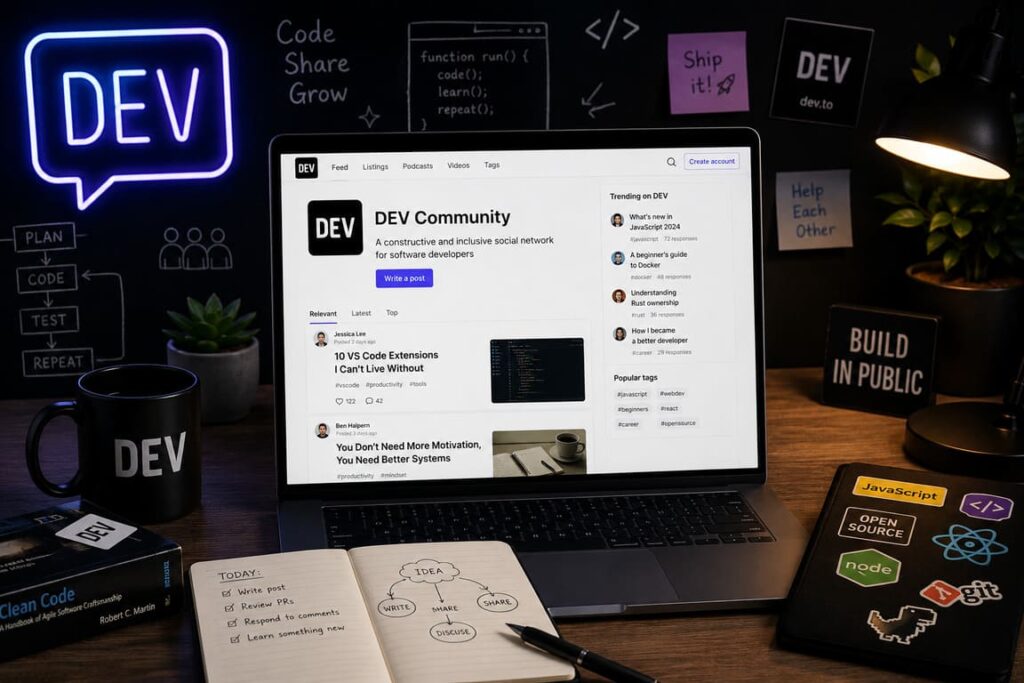

DEV Community, better known through the website dev to is one of the most recognizable places on the web for developers who want to write, learn, discuss tools, and build a professional presence in public. The official About page describes DEV as a place where software developers help one another out, built around collaboration and networked learning. That description fits the site well: it feels like a mix of blog platform, discussion forum, and career visibility tool.
DEV is also tied closely to Forem, the open-source software that powers the platform. That is one of the company’s most important facts. The codebase is public, contributors can inspect how the platform works, and the broader product vision goes beyond dev.to itself. In other words, DEV is both a website and a proof point for a larger community-building technology stack.
Unlike many content platforms, DEV is strongly shaped by its identity as a developer community rather than a generic publishing product. The homepage presents it as a community of millions of developers, and the site is organized around articles, discussions, tags, trending topics, and practical knowledge sharing. Users do not just consume content there; they also build profiles, take part in conversations, and become visible inside a technical community.
Quick Facts About DEV Community
| Category | Details |
|---|---|
| Main website | dev.to |
| Core audience | Software developers |
| Main functions | Articles, discussions, profiles, learning, community participation |
| Platform software | Forem |
| Open source | Yes |
| Tech stack | Ruby on Rails backend, Preact-first frontend direction |
| License | AGPL v3 for the core project |
| Leadership mentioned on About page | Ben Halpern, Jess Lee, Peter Frank |
What DEV Community Does Well
DEV’s biggest strength is accessibility. The site is easy to read, easy to post on, and welcoming to different experience levels. On the official open-source announcement, the company describes DEV as a large online community of software developers committed to teaching one another, building careers, and making software development more collaborative and humane. That is not just marketing language; it reflects the site’s strongest practical use case. DEV lowers the barrier to publishing technical ideas in public.
Another major strength is transparency. Because DEV is built on Forem and Forem is open source, the platform invites inspection and contribution in a way that many content sites do not. The company has said clearly that this is the real codebase that runs the platform, not a toy demo. That matters because it gives the brand more credibility with technical users. Developers can see the product, question it, improve it, and even reuse it.
The platform also benefits from a clear community identity. DEV is not trying to be everything for everyone. It is a place for posts about code, developer experience, career growth, workflows, and industry learning. That focus helps the site stay useful. Even when content quality varies, the site’s topic range stays coherent enough to make browsing worthwhile for developers.
The Company and Product Behind the Site
An important fact many casual users miss is that DEV is part of a larger ecosystem around Forem. Forem is described in the official repository as open-source software for building communities of many kinds, not just developer communities. DEV is the best-known implementation, but the underlying software is intended to be reusable across different niches. That gives the company a wider product identity than the website alone suggests.
The technical side is also worth noting. Forem’s repository describes a Ruby on Rails backend, a Preact-first frontend direction, PostgreSQL with pgvector support for AI embeddings, and deployment tooling through Kamal 2. This is useful review context because it shows the platform is not only community-oriented, but also technically serious and actively modernized.
DEV has also emphasized values like constructive dialogue, contribution quality, and code of conduct standards. In the open-source post, the team even says AI-assisted pull requests are welcome, but low-quality output is not. That small detail is actually an interesting fact because it captures the platform’s tone: open to experimentation, but still demanding standards.
Interesting Facts About DEV Community
- DEV is powered by Forem, and Forem can be used to build other communities beyond software.
- The company says DEV is a for-profit business, but it presents itself as mission-driven and focused on an inclusive developer ecosystem.
- The core project uses the AGPL v3 license, a strong copyleft license often chosen for networked software.
- DEV says it has joined forces with Major League Hacking (MLH), connecting the publishing community with a larger hands-on learning ecosystem.
Where DEV Community Feels Less Perfect
From a reviewer’s point of view, DEV’s biggest weakness is also a common weakness of open publishing platforms: content quality is uneven. The site makes it very easy to post, which is great for inclusiveness, but that also means not every article has the same depth or originality. Readers sometimes need to filter carefully to find the most useful material. This is less a flaw in the company’s mission than a normal side effect of community publishing.
Another limitation is that DEV can blur the line between community content, personal branding, and professional marketing. That is not unique to DEV, but it is part of the experience. Some users love the visibility and networking side, while others may prefer a more tightly curated editorial environment. Still, if you understand DEV as a community platform first and a polished magazine second, the product makes much more sense.
Final Verdict on DEV Community
DEV remains one of the most useful and approachable developer websites on the internet. It succeeds because it gives developers an easy way to publish ideas, learn in public, and join a recognizable technical community. It also stands out because the company behind it chose openness: open-source software, visible leadership, and a platform model that others can study and reuse.
As a website, DEV is practical, friendly, and still highly relevant. As a company product, it is smarter than it first appears because it doubles as the flagship example of Forem. The result is a platform that is not only good for reading and writing, but also interesting as infrastructure. If you want a developer-focused site with a strong community feel, DEV is still one of the easiest recommendations to make.
FAQ About DEV Community
What is DEV mainly for?
DEV is mainly for developers who want to write articles, join discussions, learn from others, and build a visible profile in the software community.
Is DEV open source?
Yes. DEV is built on Forem, and the platform’s codebase is openly available.
Who runs DEV?
The About page says DEV is led by Forem co-founders Ben Halpern, Jess Lee, and Peter Frank.
What makes DEV different from a normal blog platform?
It is not just a place to publish posts. It combines writing, discussion, developer identity, and community interaction in one ecosystem.