
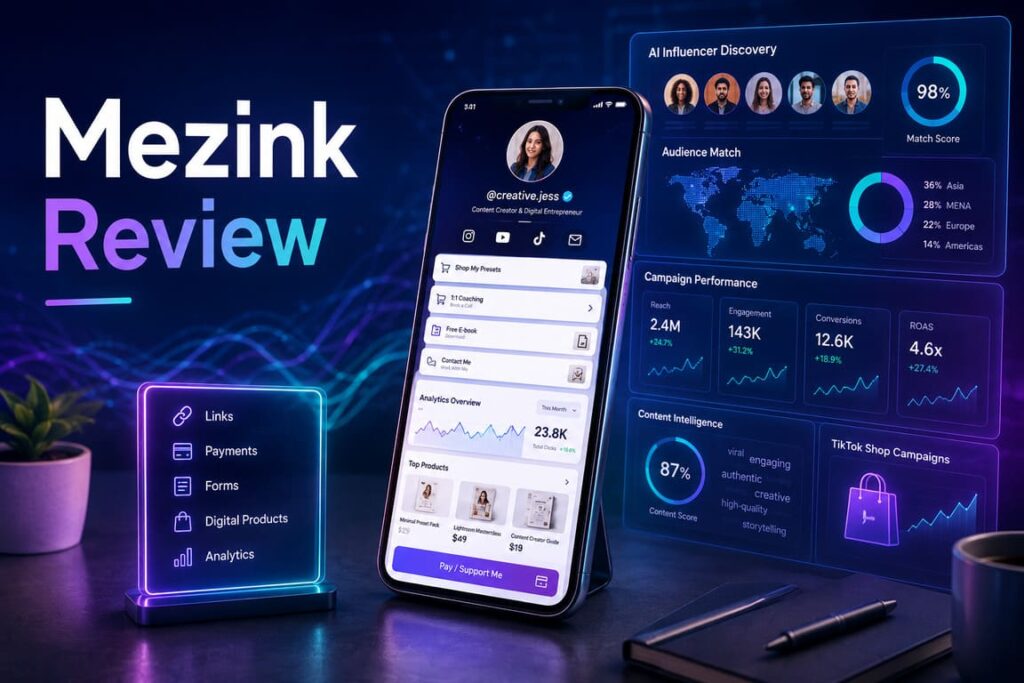

Mezink is harder to classify than most creator platforms.
At first glance, it looks like a link-in-bio tool. Open the product pages or the mobile app listings, and that is exactly what you see: a simple page builder for creators, freelancers, and small online sellers who want one smart landing page with links, forms, payments, and basic analytics. But the main website now pushes a different message. There, Mezink presents itself as an AI-powered influencer marketing company with campaign automation, creator discovery, performance forecasting, and TikTok Shop support. That split identity is the first important thing to understand before judging the product.
That dual positioning is not necessarily a flaw. In fact, it may be Mezink’s most interesting quality. It is trying to serve both sides of the creator economy: creators who need a storefront-style profile page, and brands that want structured influencer campaigns instead of messy outreach through DMs and spreadsheets. The upside is breadth. The downside is that Mezink can feel less focused than category leaders that do one thing exceptionally well.
Company Overview
What Mezink is
Mezink is a creator-economy platform built by Super Creator Tech. Public-facing materials describe it in two ways. One is as a link-in-bio and lightweight site builder with payments, forms, analytics, and store features. The other is as an AI-powered influencer marketing platform for brands running campaigns across TikTok, Instagram, and YouTube. In plain terms, Mezink sits somewhere between Linktree, a mini-commerce page builder, and an influencer campaign operating layer. Source
Founding, creators, mission, and milestones
According to Mezink’s own story page, the company was started by IIT graduates Mohit Garg and Tarun Valecha after they saw that influencer marketing was still being run through DMs, spreadsheets, and manual reporting. The stated mission is to make creator-led marketing measurable, automated, and easy to scale. The founders frame Mezink as a way to give brands ad-like structure while also helping creators earn more from their audiences.
One detail is worth noting because it says something about the maturity of the company’s public communication. The same About page says the founders “built Mezink” in 2021, but the “Mezink by the numbers” section on that page lists the company as founded in 2019. That does not make the company untrustworthy, but it does suggest that some public-facing information has not been fully harmonized. For a platform that sells clarity and measurement, that inconsistency stands out.
Mezink also claims some meaningful scale. The About page says it supports more than 1 million creators across 10+ countries, has 35+ team members across SEA, MENA, and India, and has reached $300K+ monthly ARR. The homepage separately says 100+ brands have worked with Mezink and highlights operations across Asia-Pacific, the Gulf region, and the Americas. Those numbers indicate a business with genuine regional reach, even if most public case-study detail is still thin.
Mezink at a glance
| Category | What stands out |
|---|---|
| Core identity | Hybrid product: creator link-in-bio tool plus influencer marketing platform |
| Founders | Mohit Garg and Tarun Valecha |
| Public founding timeline | 2021 in story section; 2019 in “by the numbers” section |
| Stated mission | Make creator-led marketing measurable, automated, and scalable |
| Main user groups | Creators, freelancers, online sellers, talent managers, and brands |
| Main surfaces | Web platform, iOS app, Android app, Shopify app |
| Public scale claims | 1M+ creators, 10+ countries, 100+ brands, 35+ team members |
| Geographic footprint | Singapore, Malaysia, Indonesia, India, UAE; broader campaign footprint on homepage |
Sources: Shopify App Listing
Features and Functionality
Core features
The creator-facing feature set is broader than a standard “one link in bio” product. Mezink supports link pages, profile customization, social embeds, form links, payment links, invoice links, digital-product sales, collections, and analytics. The product pages and app listings repeatedly stress fast setup and no-code use, which suggests the platform is designed less for designers and more for people who want to launch quickly from a phone.
On the brand side, Mezink’s homepage pushes a separate stack: AI-powered creator discovery, audience matching, campaign evaluation, content intelligence, automated reporting, and TikTok Shop creator marketing. This matters because it changes how Mezink should be judged. It is not just trying to be prettier than Linktree. It is trying to become an operating system for creator campaigns. That ambition gives it a more strategic angle than many bio-link tools.
Unique tools
A few tools make Mezink more interesting than the average bio page builder:
- Form links for lead capture and signups
- Payment collection and invoicing inside the creator page flow
- Shopify integration for product collections
- Auto DM as part of the broader product suite
- AI-driven influencer discovery and campaign scoring on the brand side
The best way to think about this is that Mezink wants to turn a static profile page into a small business hub. For creators selling presets, ebooks, services, or consultations, that is useful. For brands, the AI campaign claims are potentially more valuable than the bio page itself.
Interface and usability
The product is clearly optimized for simplicity. Both app listings describe a guided setup flow: sign in, choose a username, pick a template or theme, add links, and publish. That is the right design choice for creators who do not want to learn a full website builder. The trade-off is obvious too: ease of setup usually means less deep layout control than a more flexible site builder like Carrd.
Mobile and desktop experience
Mezink seems strongest on mobile. The iOS listing presents it as a quick site-builder app with in-app purchases and a mobile-first publishing flow. The Android listing does the same. On Apple’s App Store, the app has a 4.3/5 rating from 20 ratings, supports iPhone, iPad, and Apple Silicon Macs, and offers Premium and Professional tiers. That is a respectable sign, though not a huge review base. Desktop web use exists, but the public product language feels much more phone-native than desktop-native.
Target Audience
Who it is designed for
Mezink is best suited to people who want to turn social traffic into something more useful than profile visits.
That includes creators, freelancers, affiliate marketers, micro-merchants, digital-product sellers, talent managers, and DTC brands running creator campaigns. A casual user who only needs five links and a profile photo can use Mezink, but that person may not get the full benefit of the platform’s extra layers.
Best use cases
The platform makes the most sense in these situations:
- A creator wants one page for links, donations, products, and inquiries.
- A freelancer needs a lightweight mobile portfolio with payment collection.
- A Shopify merchant wants social traffic to flow into curated product collections.
- A talent manager or brand wants a creator database and more structured campaign workflows.
A typical Mezink workflow
- Create a profile and choose a username.
- Add social links, product links, forms, or payment links.
- Customize the page theme and layout.
- Publish the page in Instagram, TikTok, YouTube, WhatsApp, or email.
- Track clicks and engagement through analytics.
- If using the brand side, match creators, run campaigns, and monitor performance.
Pricing and Monetization
Free features and paid plans
Mezink’s public pricing is partly straightforward and partly fuzzy.
The creator app clearly offers a free entry point. The iOS listing shows paid options: Mezink Premium at $5.99 monthly or $59.99 yearly, and Mezink Professional at $19.99 monthly or $199.99 yearly. The Shopify app is listed as free. The link-in-bio product page emphasizes transparent pricing and free access, but it does not present the kind of detailed public pricing table that Linktree and Carrd do. That makes comparison harder than it should be.
Public pricing snapshot
| Plan / access point | Publicly visible price | What it appears to cover |
|---|---|---|
| Core app free tier | Free | Basic link-in-bio and creator-page usage |
| Premium | $5.99/month or $59.99/year | Mid-tier creator features |
| Professional | $19.99/month or $199.99/year | Higher-end creator/business use |
| Shopify app | Free | Social storefront connection for Shopify merchants |
Sources:
Value for money
For creators who want payments, forms, and simple commerce in one place, Mezink’s pricing looks competitive. Linktree’s public plans run from free to $35 per month depending on features, while Carrd stays much cheaper but is more of a general one-page builder. Beacons pushes harder into monetization, AI tooling, and creator commerce, but its higher paid tiers can become more expensive than Mezink’s public app plans. In value terms, Mezink looks strongest for users who want a practical “sell and collect” stack without paying enterprise-style prices.
Security and Privacy
Mezink’s privacy documentation is more detailed than many small creator tools. The company says it collects names, email addresses, phone numbers, and other user-provided information, and also describes Google Workspace data handling for Mail Merge-style functionality. It states that Google API data is used only for user-facing features and references Google’s Limited Use policy. It also outlines rights for EEA, UK, and California residents, including access, deletion, and portability requests.
That said, the same documents include a familiar but important caveat: Mezink says it uses technical and organizational safeguards, but cannot guarantee that internet transmission or storage is fully secure. In other words, the legal language is serious, but not unusually strong. I also did not find a clear public mention of two-factor authentication in the documents reviewed, which is not ideal for a product touching payments, business inquiries, and creator data. Source
The iOS privacy label also deserves attention. Apple’s listing says the app may use contact info, identifiers, usage data, sensitive info, and diagnostics for tracking across apps and websites, and may collect financial info and contact data linked to identity. That does not automatically mean Mezink is reckless with data, but it does mean privacy-sensitive users should read the disclosures carefully before adopting it as their central business page.
Community and Ecosystem
Mezink’s ecosystem is still emerging rather than dominant. The company claims 1M+ creators and operations across multiple countries, which suggests regional traction. But compared with category leaders, the public community layer looks lighter. You do not see the same level of template ecosystem, third-party tutorial universe, or extensive help-center depth that surrounds Linktree, Carrd, or Beacons.
Where Mezink does show practical ecosystem value is integrations. Shopify support is public. Social embeds are central. The app listings mention WhatsApp, Telegram, YouTube, Spotify, TikTok, Instagram, and marketplace links like Amazon and Shopify. That is enough for many solo operators, even if it is not yet a fully mature developer platform.
Competitor Comparison
How Mezink compares with Linktree, Beacons, and Carrd
| Platform | Best for | Main strength | Main weakness | How it differs from Mezink |
|---|---|---|---|---|
| Mezink | Creators and brands that want links plus commerce and campaign tools | Mix of link page, payments, forms, and influencer-marketing layer | Public positioning is split and documentation is uneven | More brand-campaign ambition than most bio-link tools |
| Linktree | Mainstream creators and brands | Very polished ecosystem, clear pricing, strong monetization options | Can get expensive on higher tiers | More mature and focused, but less unusual in scope |
| Beacons | Monetizing creators | Deep creator commerce, AI tools, media kits, email, brand-deal tooling | Higher complexity and potentially higher paid-tier cost | Closest rival in breadth; Beacons feels more creator-monetization-first |
| Carrd | Users who want cheap, flexible one-page sites | Low cost and strong layout freedom | Less specialized for creator funnels and campaign tooling | Better for builders; worse for plug-and-play creator ops |
Sources: Linktree Pricing, Beacons Pricing, Carrd Pro
Real-World Usage
In practice, Mezink is most useful when someone has more than a social profile and less than a full website budget.
A creator can use it to collect payments, link social channels, gather leads, and sell a few digital items. A freelancer can use it as a mini portfolio and invoice hub. A merchant can turn it into a mobile storefront that sits between Instagram traffic and a Shopify catalog. And a brand team can treat it as an entry point into creator discovery and campaign operations. Those are sensible, practical workflows.
What is less visible is proof depth. Mezink claims brand relationships, global presence, and creator scale, but public case studies and independently visible merchant reviews are still limited. That means buyers need to trust the platform’s pitch more than they might with older, more documented rivals.
Interesting Facts
Five things that are easy to miss
- Mezink publicly presents two identities at once: a creator bio-link tool and an AI influencer-marketing platform.
- Its own About page contains a founding-date inconsistency: 2021 in the origin story, 2019 in the metrics section.
- The iOS app offers compatibility beyond iPhone and iPad, including Apple Silicon Macs and Apple Vision support.
- Mezink has a public Shopify app, but it currently shows no reviews, which is unusual for a commerce-facing integration.
- Its privacy policy includes region-specific rights language for EEA, UK, and California users and references Google API data restrictions, which is more formal than many small creator tools publish
Strengths and Weaknesses
Pros and cons table
| Pros | Cons |
|---|---|
| Broader than a basic link-in-bio tool | Brand message is split between creator tool and agency platform |
| Good mix of forms, payments, commerce, and analytics | Public pricing is less transparent than some rivals |
| Competitive paid plans on iOS listing | Limited public proof compared with larger competitors |
| Shopify integration adds practical ecommerce value | Small public review footprint in some channels |
| Brand-side AI campaign tooling could be genuinely useful | No clear public mention of 2FA in reviewed materials |
FAQ
1. Is Mezink just a Linktree alternative?
No. It can work that way, but it also adds forms, payments, invoicing, product collections, and a brand-facing influencer-marketing layer.
2. Who founded Mezink?
Public materials name Mohit Garg and Tarun Valecha as founders.
3. When was Mezink founded?
The public timeline is inconsistent. One section says the company was built in 2021, while another says it was founded in 2019.
4. Does Mezink have a free plan?
Yes. The app listings describe free usage, and paid tiers are offered as upgrades.
5. Can Mezink be used for selling products?
Yes. Public materials mention payments, digital goods, product collections, and Shopify integration.
6. Is Mezink good for brands, not just creators?
Potentially yes. The homepage is heavily aimed at brands running creator campaigns, with AI discovery, evaluation, and content intelligence features.
7. How strong is Mezink’s privacy posture?
Better documented than many small tools, but still conventional. The company outlines data use and user rights, yet also states that no system can be guaranteed fully secure.
8. Should a design-heavy user choose Mezink or Carrd?
If design freedom matters most, Carrd is likely the better fit. If quick monetization and creator workflows matter more, Mezink is the better candidate.
Expert Verdict
Mezink is most appealing when you look at it as a practical creator-business tool, not just as a pretty profile page.
Its strongest idea is not the bio link itself. It is the attempt to connect audience traffic, lead capture, payments, storefront elements, and influencer operations in one ecosystem. That makes Mezink more ambitious than many simpler competitors. At the same time, the platform still feels like a company in transition. Its public identity is mixed, some documentation is inconsistent, and the social proof around integrations and reviews is not yet as deep as the biggest names in the category.
Who should use it? Creators who want one mobile-friendly page that can actually do business. Freelancers and small sellers fit well too. Brands exploring creator marketing may also find the broader Mezink story attractive. Who may prefer alternatives? Users who want the most polished mainstream bio-link ecosystem should look at Linktree. Users who want stronger creator commerce and media-kit tooling should compare Beacons carefully. Users who care more about design freedom than creator workflows will probably prefer Carrd.