
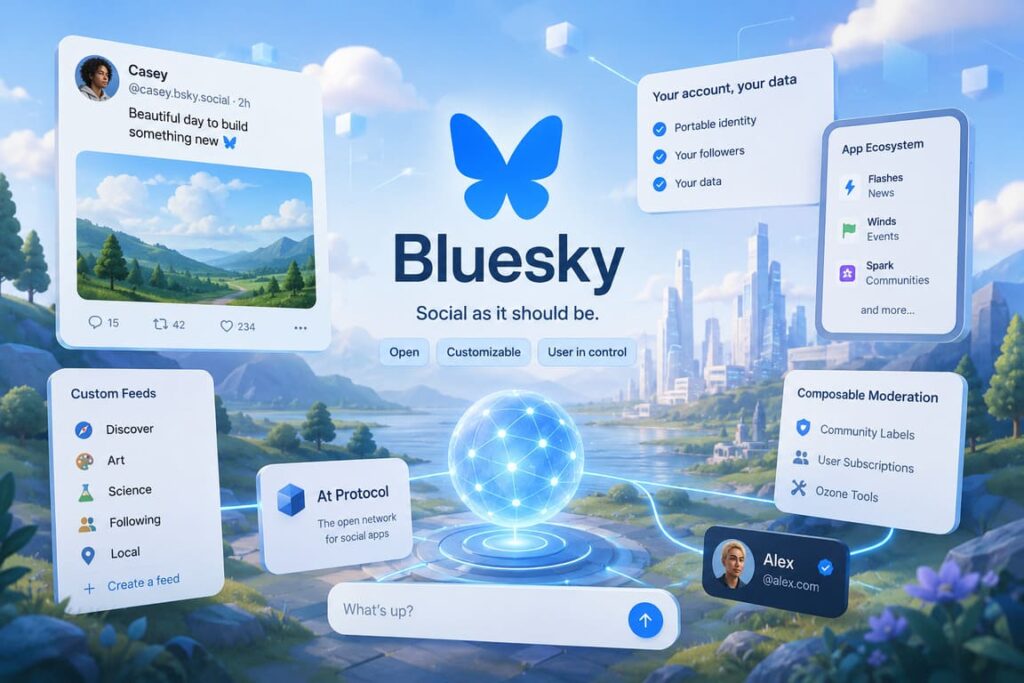

Bluesky is a social networking platform built around a very different idea from most mainstream social apps. Instead of locking users into one company’s system, Bluesky is built on the AT Protocol, an open framework for social apps. The company describes this as a way to make social media feel more like the early web, where identity, content, and connections are more portable and less controlled by a single platform owner. That vision is what makes Bluesky stand out in a crowded market.
Bluesky is also not just a prototype anymore. According to the company’s FAQ, the platform had over 42 million users as of February 2026, which shows that it has moved far beyond being a niche alternative for early adopters. The company was originally connected to Jack Dorsey’s effort at Twitter, but it has been an independent company since 2021 and now operates as Bluesky Social PBC, a Public Benefit Corporation.
What makes Bluesky especially interesting is that it is trying to be both a user-friendly app and part of a larger open ecosystem. The company says the goal is not simply to build another Twitter-like product, but to support a broader network where different apps and services can interoperate. That bigger ambition gives Bluesky more depth than a normal social app launch.
Quick Facts About Bluesky
| Category | Details |
|---|---|
| Full company name | Bluesky Social PBC |
| Main product | Bluesky social app |
| Website | bsky.app |
| Core technology | AT Protocol |
| Company structure | Public Benefit Corporation |
| User base | Over 42 million users as of February 2026 |
| Key product ideas | Account portability, custom feeds, composable moderation, open ecosystem |
What Makes Bluesky Different
The biggest difference is portability. Bluesky says users should be able to move between services without losing their identity, posts, or social graph. In simple terms, leaving one host should not mean starting over from zero. That is a major contrast with traditional social networks, where your audience and identity are usually trapped inside one company’s product.
Another major difference is algorithmic choice. On Bluesky, users are not limited to one default timeline algorithm. The platform supports a large ecosystem of custom feeds, and the company says there are tens of thousands of them. That means users can shape their experience around interests, communities, and topics instead of accepting one opaque ranking system. This is one of Bluesky’s most user-friendly ideas because it gives people more control without forcing them to understand deep technical settings.
Moderation is also handled in a more flexible way than on most social platforms. Bluesky’s moderation architecture separates hosting, identity, and moderation services. The platform uses labels that can be interpreted by clients, and users can subscribe to additional moderation services on top of the default system. Bluesky has even open-sourced Ozone, its internal moderation tooling. This is an important and unusual move because it shows the company is trying to make moderation more transparent and modular rather than purely centralized.
The Real Strengths of Bluesky
In review terms, Bluesky’s greatest strength is that it feels like a serious attempt to rethink social media architecture instead of merely copying a competitor’s interface. The company is building for long-term flexibility: protocol-native development, future decentralized messaging, better identity systems, and a more open ecosystem for third-party developers. That gives the platform strategic depth.
Another strength is that the company is pragmatic. Even while pushing decentralization, Bluesky has not tried to make every feature perfectly pure from day one. Its roadmap notes that the team launched a more basic centralized direct messaging system while still planning more protocol-native solutions later. That balance between idealism and practicality is healthy. It suggests the company understands that users want working products, not just elegant ideas.
Trust features have also evolved. In 2025, Bluesky introduced a new verification system with visible badges and a Trusted Verifiers model, while still encouraging domain-based identity as a strong verification method. The company reported that more than 270,000 accounts had linked their username to a website domain. That is an interesting fact because it shows Bluesky is trying to make identity more web-native and less dependent on a platform-only badge.
Interesting Facts About Bluesky
- Bluesky was initially kicked off when Jack Dorsey was still CEO of Twitter, but it later became an independent company.
- The company raised a $15 million Series A in 2024 and said clearly that the Bluesky app and AT Protocol do not use blockchains or cryptocurrency, despite the lead investor being Blockchain Capital.
- Bluesky says it launched features like direct messages, GIFs, video, starter packs, and federation while also investing in trust and safety.
- The company positions Bluesky not only as an app, but as part of an ecosystem that could support other apps like events, forums, and audio products.
Where Bluesky Still Has Challenges
No review is complete without trade-offs. Bluesky’s open design is exciting, but it can also be harder for average users to understand. Ideas like federation, labelers, protocol-native identity, and portable hosting are powerful, but they are also more complex than a standard sign-up-and-scroll model. Some users will love that depth; others may never care about it. That tension is part of the platform’s identity. Source
The other challenge is that building an open network takes time. Bluesky’s own roadmap makes clear that some long-term goals are still in progress, including deeper decentralization, better private content systems, and future protocol governance. That is not a flaw by itself, but it does mean Bluesky is still a platform in motion rather than a finished product.
Final Verdict on Bluesky
Bluesky is one of the most important social web projects to watch because it combines a clean user-facing app with a serious technical mission. It is not interesting only because it is new, or because it benefited from public frustration with older social networks. It is interesting because it is trying to solve structural problems: lock-in, opaque moderation, platform dependency, and weak identity control.
As a website and company, Bluesky looks ambitious, modern, and unusually transparent in its goals. It already has scale, a clear product philosophy, a growing verification model, funding, and a broader ecosystem strategy. The main downside is that its biggest ideas are also the ones that may feel most abstract to mainstream users. Still, if you want a platform with fresh momentum and a bigger vision than “just another feed,” Bluesky is one of the strongest names in social media right now.
FAQ About Bluesky
What is Bluesky mainly used for?
Bluesky is mainly used for public conversation, short posts, community discovery, and following custom feeds, but it is also part of a wider open social ecosystem built on the AT Protocol.
Is Bluesky decentralized?
Yes, but in a practical and evolving way. The platform is built on the AT Protocol, supports federation and portability, and is moving toward deeper decentralization over time.
How does verification work on Bluesky?
Bluesky uses both domain-based identity and a newer badge-based verification system. It also allows selected trusted organizations to verify accounts.
What is Bluesky’s biggest advantage?
Its biggest advantage is user control: portable identity, custom feeds, and more flexible moderation compared with traditional closed social networks.