
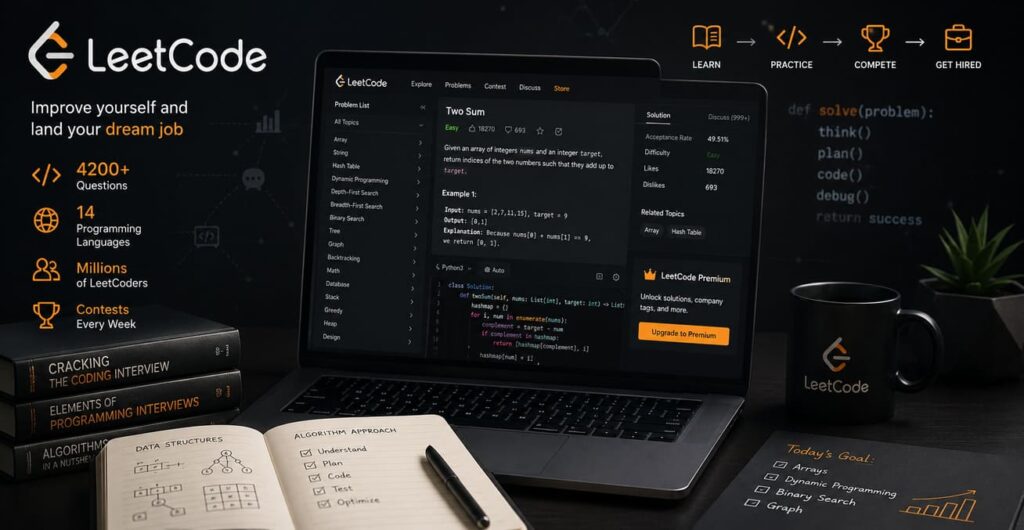

LeetCode is one of the most recognized names in technical interview preparation, but calling it only a “coding problem website” would be too narrow. It is better understood as a career-oriented programming platform built around practice, structured learning, contest culture, and hiring-related tools. On its homepage, LeetCode says its mission is to help users improve themselves and land their dream job. That framing matters, because the platform is clearly designed not just for learning syntax, but for performing well in interview-style environments.
The scale of LeetCode is one of its biggest selling points. The company says it offers more than 4200 questions, supports 14 popular coding languages, and has one of the largest tech communities with hundreds of thousands of active users. That gives the platform a kind of gravity: even if users do not love every part of the interview-prep culture, it is hard to ignore a site with this many problems, discussions, contests, and company-focused learning paths.
LeetCode also has a strong company and founder story. Winston Tang is identified as the founder of LeetCode, and his Built In profile says he created the platform to help engineers practice coding skills and prepare for technical interviews. The same profile notes that he previously worked as a developer at Google and a software engineer at Amazon. Combined with LeetCode’s own “Made with in SF” messaging, this gives the brand a Silicon Valley career-prep identity that matches its product direction.
LeetCode at a glance
| Category | Details |
|---|---|
| Product type | Technical interview prep and coding practice platform |
| Founder | Winston Tang |
| Core mission | Help users improve themselves and land their dream job |
| Problem library | 4200+ questions |
| Supported languages | 14 popular coding languages |
| Learning products | Problemset, Explore, contests, interview prep tracks |
| Business offering | Online coding interview platform for professionals |
| Premium examples | $35/month or $159/year on the subscription page |
Table based on official platform pages and founder profile.
What LeetCode does better than many alternatives is structure. A huge library of problems can be overwhelming, but LeetCode adds multiple layers on top of raw practice. The Explore section includes learning paths such as Interview Crash Course for data structures and algorithms, System Design for Interviews and Beyond, Beginner’s Guide, Arrays 101, Dynamic Programming, SQL, Graph, Heap, and more. There are also premium interview tracks for companies such as Google, Facebook, Microsoft, Amazon, and Apple. This matters because many learners do not fail from lack of effort; they fail because they do not know what to study next.
The problemset itself is another strength. It is not just large; it is well organized. Users can filter questions by topic such as arrays, strings, hash tables, dynamic programming, math, sorting, greedy methods, graphs, trees, stacks, databases, sliding windows, and backtracking. They can also sort or filter by acceptance rate, difficulty, solution availability, frequency, status, and day. This kind of filtering turns a giant archive into something more focused and usable, especially for people targeting a specific weakness or interview pattern.
Premium is where LeetCode becomes more tactical. The subscription page highlights premium video solutions, exclusive content, company-specific question groupings, autocomplete, debugger access, faster judging, question prevalence sorting, interview simulations, unlimited playgrounds, discounts, and cloud storage. The pricing shown on the page is $35 per month or $159 per year. For serious job seekers preparing for a recruiting cycle, the company-specific and frequency-based features are probably the most valuable part, because they help narrow attention to the questions most likely to matter.
LeetCode is also not just for candidates. Its LeetCode Interview product positions the company as a tool for interviewers and recruiting teams. The official page describes it as an online coding interview platform with instant Judger results, stable connectivity, video and voice chat, code collaboration, frontend framework support, whiteboard features, and question sets drawn from LeetCode’s broader challenge library. The page also says the community around LeetCode includes millions of LeetCoders, showing that the brand sees itself as both a practice platform and a talent ecosystem.
What LeetCode is best at
- Interview-specific preparation. It aligns closely with the style of technical screening used by many software companies.
- Structured progression. Explore and curated tracks reduce the chaos of random problem solving.
- Depth of problem coverage. With 4200+ questions and rich filters, it is easy to build a focused practice plan.
- Career relevance. Premium features are clearly tuned for actual hiring outcomes, not just abstract learning.
- Business-side utility. LeetCode Interview turns the brand into more than a student tool.
That said, LeetCode is not perfect. Its biggest weakness is also part of its identity: it optimizes heavily for interview performance. That is great if you are applying for software engineering jobs, but less ideal if your main goal is building products, learning software architecture through projects, or becoming a stronger engineer through real-world system work. You can get very good at LeetCode and still need other kinds of practice to become effective in production environments. This is not exactly a flaw in the platform; it is more a limitation of scope. Still, users should be honest about why they are there. The site is strongest when used as one part of a larger learning strategy.
Strengths and weaknesses of LeetCode
Main strengths
- Huge problem library
- Strong filtering and categorization
- Good structured learning tracks
- Clear value for interview prep
- Useful premium targeting tools
- Real interviewer/recruiter product on top of the learner platform
Main weaknesses
- Can encourage interview-style optimization over practical software building
- Premium is useful, but some of the most valuable targeting features are paywalled
- The platform can feel intimidating for beginners if used without a guided plan
Interesting facts about LeetCode
- The platform says it supports 14 popular coding languages.
- Its library includes over 4200 questions.
- Explore includes not only DSA content, but also system design, SQL, machine learning basics, and beginner guides.
- Premium company-focused tracks include Google, Facebook, Microsoft, Amazon, and Apple.
- LeetCode has expanded into a professional interview platform with voice, video, live coding, and whiteboard support.
Final verdict on LeetCode
LeetCode remains one of the most important platforms in software interview preparation because it understands the hiring game very clearly. It gives users a large problem base, a structured way to improve, and premium tools that match actual recruiting goals. It is not the whole answer to becoming a strong engineer, but it is one of the clearest answers to becoming better at coding interviews. If your goal is to prepare for software hiring loops efficiently, LeetCode is still one of the best places to spend your time. If your goal is broader engineering growth, it works best when paired with projects, reading, debugging, and system-building experience outside the platform.
FAQ about LeetCode
Is LeetCode only for interview preparation?
No, but interview prep is clearly the main focus. It also offers guided learning paths, contests, and broader technical content.
How many questions does LeetCode have?
The homepage says LeetCode offers more than 4200 questions.
Is LeetCode Premium worth it?
It can be worth it for users actively preparing for job applications, especially because of company-specific questions, interview simulations, video solutions, and frequency-based targeting.
Who founded LeetCode?
Winston Tang is identified as the founder, and his profile says he created LeetCode to help engineers practice coding skills and prepare for interviews.