
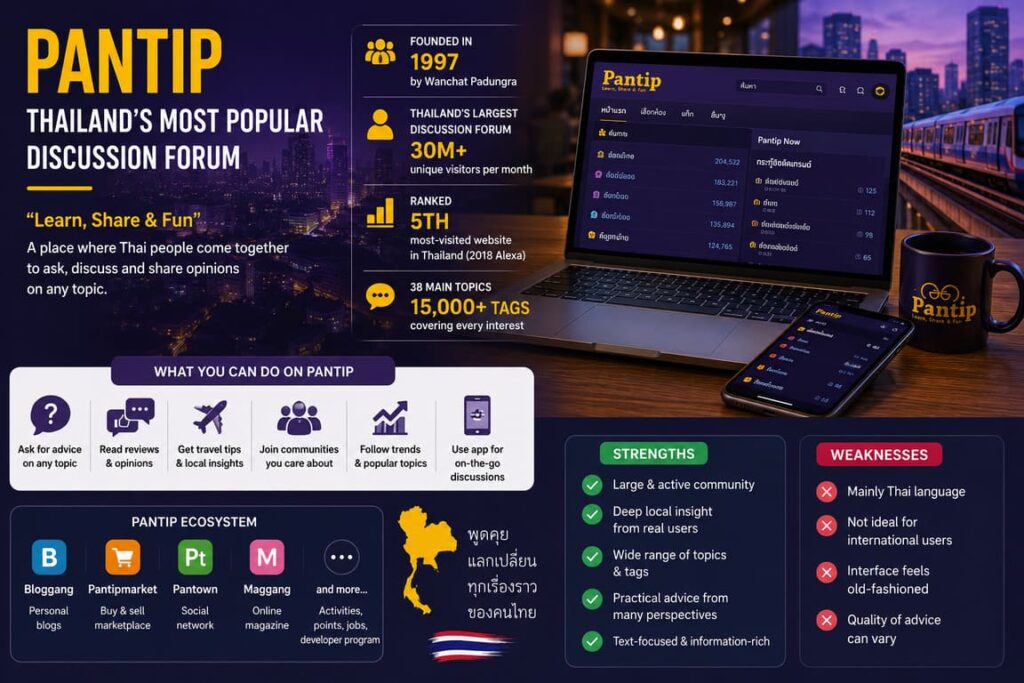

Pantip is one of Thailand’s best-known community websites. At its core, it is a large discussion forum where users ask questions, share opinions, review products and services, talk about current events, and seek advice about daily life. The official Pantip app page uses the phrase “Learn, Share & Fun,” and that short line captures the platform well. It is built around conversation, not polished personal branding
Pantip’s official About section is not very detailed in English, but it clearly shows the platform is more than one forum page. It links to related services such as Bloggang, Pantipmarket, Pantown, and Maggang, as well as app downloads, activities, a points system, posting rules, advertising, jobs, and a certified developer program. That suggests a long-running local internet brand with a broader ecosystem around the main forum.
Company and Website Facts
For company history, third-party reporting fills some of the gaps. A Yahoo Singapore profile on founder Wanchat Padungra says Pantip was founded in 1997 and grew into the largest online discussion forum in Thailand, with 30 million unique visitors a month. It also says the site started as an online magazine before growing through classifieds and then its threaded forum format. Source
Another useful outside source comes from Aquaring, which describes Pantip as one of the most-visited websites in Thailand and says it was ranked the 5th most-visited website in Thailand in a 2018 Alexa snapshot. That source also explains why the site is so sticky: many topic areas, heavy user participation, public visibility, and strong social sharing. While this is not Pantip’s own corporate reporting, it helps explain the platform’s real market position.
Why Pantip Feels Important
Pantip matters because it functions as a public opinion layer in Thai internet culture. It is not just a website people visit for fun. It is often where people go to ask what others really think. That includes travel advice, product choices, health questions, school issues, family matters, politics, entertainment, finance, and everyday decisions.
Aquaring’s breakdown is especially helpful here. It says Pantip separated forums into 38 different main topics and more than 15,000 tags, which made the platform broad enough to attract users of different ages and interests. It also explains how Pantip highlights popular threads through sections like Pantip Now, Pantip Pick, and Pantip Trend, which helps strong content rise quickly.
Table 1: Pantip at a Glance
| Category | Details |
|---|---|
| Website | pantip.com |
| Main format | Thai-language community forum |
| Core identity | Learn, Share & Fun |
| Reported founding year | 1997 |
| Founder | Wanchat Padungra |
| Key use cases | Advice, discussion, reviews, trends, current events |
| Official ecosystem links | Bloggang, Pantipmarket, Pantown, Maggang |
| Audience | Primarily Thai-speaking users |
Table 1. Quick facts about Pantip and its broader ecosystem.
What Pantip Does Well
Pantip’s biggest strength is trust through volume. The site has so many users and so many discussion threads that it often works like a public reality check. If you want to know what Thai users think about a phone, airline, restaurant, visa process, school issue, or social trend, Pantip is often one of the first places worth checking.
A second strength is topic depth. Aquaring says the forum spans dozens of major categories, from gadgets and tourism to politics, religion, sport, family, beauty, science, and business. That matters because it turns Pantip into a general-interest social knowledge base rather than a niche community.
A third strength is its role as an informal advice platform. Aquaring describes Pantip as an “alternative consulting service” for Thai people because users often ask for opinions on love, family, school, finance, and social problems. That may sound casual, but it is a real strength. Many platforms are good for content broadcasting; Pantip is good for getting many practical responses from ordinary people. Source
The Main Weaknesses
Pantip is extremely local. For Thai users, that is a major advantage. For non-Thai users, it can be a hard barrier. The site is not built for a global English-speaking audience. Translation tools can help, but much of the value comes from local context, humor, slang, and social nuance.
The interface also feels like a classic forum, not a modern visual-first social platform. Some people will love that because it puts discussion first. Others will think it feels dated.
And like every large forum, quality is uneven. Large communities produce useful advice, but they also produce noise, emotional replies, arguments, and occasional misinformation. The value comes from reading across multiple comments, not from trusting the first post you see.
Useful Things You Can Do on Pantip
- Ask for product recommendations
- Read local opinions on travel and services
- Follow Thai social trends and public reactions
- Join topic-specific communities
- Use the app for mobile discussions
- Watch how popular threads rise through community interest
Table 2: Strengths and Weaknesses of Pantip
| Area | Strengths | Weaknesses |
|---|---|---|
| Community value | Large, active, discussion-first | Can be noisy or repetitive |
| Local insight | Excellent for Thai opinion and context | Not ideal for non-Thai users |
| Topic range | Very broad forum structure | Hard to navigate at first |
| Trust factor | Many user voices on one topic | Advice quality varies |
| Platform style | Text-first and practical | Less modern and visual |
Table 2. A practical review of Pantip’s main pros and cons.
Interesting Facts About Pantip
- Pantip reportedly started in 1997 as an online magazine before evolving into a forum-led community site.
- The founder reportedly built part of the idea after noticing the lack of Thai-language web content in the early internet era.
- Aquaring says Pantip had 38 main topic groups and 15,000+ tags, which helps explain its breadth.
- Pantip’s own About section links to a bigger family of services, including Bloggang and Pantown.
Final Verdict
Pantip is one of the clearest examples of a local web giant that still matters because it solves real user problems. It helps people learn, compare opinions, ask questions, and understand what other Thai users think. That is more valuable than it may first appear. In a world full of polished short-form content, a strong discussion forum can still be extremely useful.
If you want deep local insight into Thailand, Pantip is far more useful than many global social networks. If you do not read Thai, the platform becomes harder to use, but it is still worth knowing because it reflects real Thai online conversation. Its age, breadth, and persistence make it one of Southeast Asia’s more interesting community websites.
FAQ About Pantip
What is Pantip mainly used for?
Pantip is mainly used for discussions, questions, advice, reviews, and trending Thai topics.
Is Pantip a social media platform or a forum?
It is best described as a large discussion forum and community platform.
When was Pantip founded?
A third-party founder profile says it was founded in 1997.
Why is Pantip important in Thailand?
Because it is a major Thai-owned discussion platform with broad topic coverage and strong public participation.
Is Pantip good for non-Thai users?
Only partly. It is most useful if you read Thai or need local Thai opinions badly enough to use translation tools.