
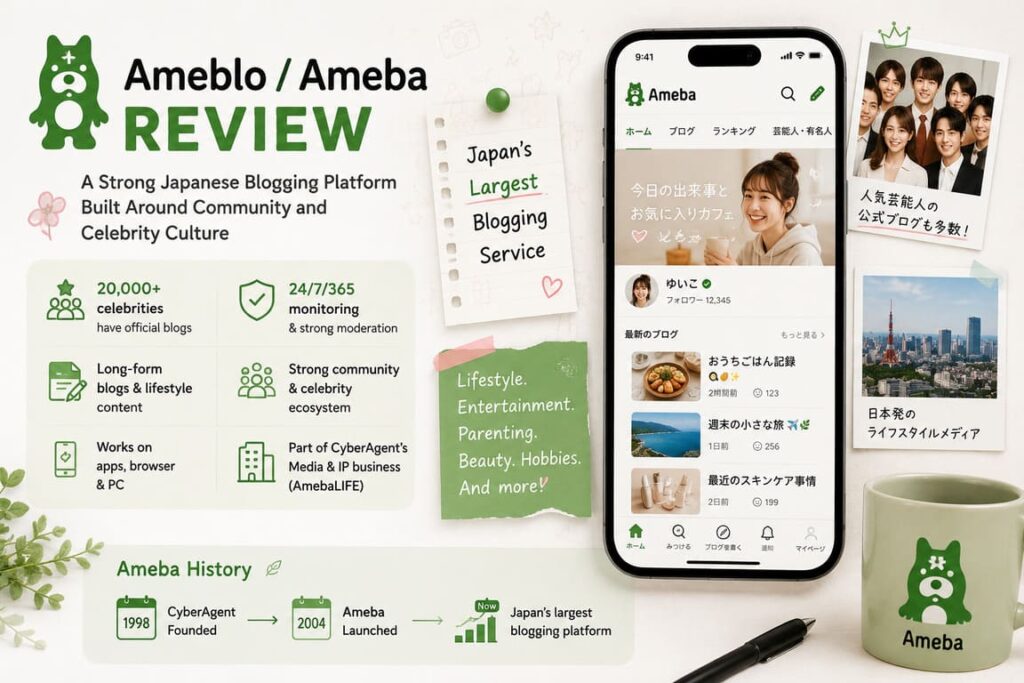

Ameblo is one of the best-known blog platforms in Japan. It sits inside the broader Ameba brand, which is operated by CyberAgent. CyberAgent’s own service page describes “Ameba Blog” as the nation’s largest and most popular blog service. It also says that more than 20,000 celebrities have official blogs on the platform, which is one of the clearest reasons the site became so influential in Japanese internet culture.
This is important because Ameblo is not just a blogging tool. It works more like a full lifestyle media platform. The official About page says AmebaLIFE is a lifestyle division under CyberAgent’s Media & IP business, focused on enriching everyday life. That gives the service a broader identity than a simple publishing site. It is part blog network, part content hub, and part entertainment ecosystem.
Company Background and Key Facts
Ameba was launched in September 2004, according to CyberAgent’s official history page. CyberAgent itself was founded in 1998, so Ameba came after the company had already built a broader internet business. Over time, CyberAgent expanded into advertising, games, AI, DX, and media, but Ameba remained one of its most recognizable consumer internet brands.
CyberAgent’s investor materials also explain where Ameba sits strategically. The company says it launched Ameba in 2004 and that it became Japan’s largest blogging service. Even though CyberAgent now puts heavy focus on ABEMA and its IP business, Ameba still matters because it helped build CyberAgent’s media presence and social reach. Source
Why Ameblo Still Matters
Ameblo’s biggest strength is cultural fit. It feels built for Japanese users rather than for a global audience. That means the design, topics, celebrity tie-ins, and user habits all make sense in the local market. It is especially strong in entertainment, lifestyle, parenting, beauty, hobby writing, and fan communities. CyberAgent’s service page highlights entertainment news and free games alongside blogs, which shows how the platform grew by mixing publishing with broader media habits.
Another major reason for its staying power is celebrity blogging. The fact that more than 20,000 celebrities have official blogs on Ameba gave the platform a kind of built-in media relevance. On many global blogging platforms, creators have to bring their own audience. On Ameblo, the platform itself became a destination because well-known public figures were already there. That created a loop: readers came for celebrity posts, stayed for communities, and then built their own blogs.
Table 1: Ameblo / Ameba at a Glance
| Category | Details |
|---|---|
| Website | ameblo.jp / ameba.jp |
| Parent company | CyberAgent |
| Launch year | 2004 |
| Core service | Blogging and lifestyle media |
| Key audience | Japanese readers, bloggers, celebrity fans, lifestyle communities |
| Standout fact | 20,000+ celebrities have official blogs |
| Device support | Smartphone apps, browser, PC browser |
| Brand position | Part of CyberAgent’s Media & IP business |
Table 1. Quick facts about Ameblo and the company behind it.
The Best Things About Ameblo
The platform’s biggest advantage is that it feels human. Instead of pushing short-form content and endless algorithmic noise, it gives more room for diary-style writing, personal updates, long captions, and topic-based blog posts. That makes it more personal than many modern social platforms.
It also has a strong built-in identity. Users know what kind of place it is. Ameblo is not trying to be everything for everyone. It leans into celebrity blogging, lifestyle content, and Japanese community culture. That focus helps it stay useful.
A few practical strengths stand out:
- Strong celebrity presence
- Clear brand identity in Japan
- Long-form posts work better than on most social apps
- Useful on both mobile and desktop
- Integrated into a larger media company ecosystem
- Feels more community-based than many fast-content platforms
Safety and Moderation
CyberAgent also gives unusually clear detail about safety operations across its media services, including Ameba. The company says it runs a 24/7/365 monitoring system, combines human moderation with system-based filters, blocks inappropriate postings, and restricts some features for underage users. For example, it lists communication and search restrictions for younger users and monthly payment caps for under-18 users on the Ameba platform.
That matters in a review because it shows Ameblo is not just a casual legacy blog site running on autopilot. It is still managed as part of a serious media environment with active moderation and youth-protection rules. For parents and younger users, that is a real advantage.
Where Ameblo Feels Weak
Ameblo’s biggest weakness is also obvious: it is mainly a Japanese-language platform. If you are outside Japan or do not read Japanese, the site is much less useful. It is not designed first for global discovery in the way Medium, WordPress, or Substack often are.
The interface can also feel crowded. That is common on long-running Japanese web services. Some users will find it rich and familiar; others will think it looks dated compared with modern minimalist platforms.
And while celebrity presence is a strength, it can also make the platform feel less open or less independent than blog spaces built around unknown writers and niche experts.
Table 2: Strengths and Weaknesses of Ameblo
| Area | Strengths | Weaknesses |
|---|---|---|
| Content style | Good for personal, lifestyle, and fan-focused blogging | Less useful for international professional writing |
| Brand value | Very strong in Japan | Limited relevance outside Japan |
| Community | Strong celebrity and reader ecosystem | Harder for non-Japanese users to join |
| Safety | Clear moderation and underage protections | Some users may feel moderation is strict |
| User experience | Works across app and browser | Interface can feel busy or old-fashioned |
Interesting Facts About Ameblo
- Ameba launched in 2004, which means it survived many major shifts in internet culture.
- More than 20,000 celebrities have official blogs on the platform. That is one of its biggest differentiators.
- CyberAgent says Ameba became Japan’s largest blogging service, which explains why the brand still carries weight.
- CyberAgent applies 24/7/365 monitoring and age-based restrictions across services including Ameba.
Final Verdict
Ameblo is a strong platform if your goal is to understand Japanese internet culture, follow celebrity blogs, or publish lifestyle-oriented content in Japanese. It is less universal than global blogging platforms, but that is also why it works. It knows its audience. It does not try to flatten everything into one style of content.
As a company product, Ameblo also benefits from being part of CyberAgent, a large and diversified internet business. That gives it more operational stability than many independent blog platforms. If you want a blogging service with deep roots in Japan and a proven media identity, Ameblo remains one of the most important names in that market.
FAQ About Ameblo / Ameba
What is Ameblo mainly used for?
It is mainly used for blogging, lifestyle content, celebrity updates, and community-based reading in Japan.
Who owns Ameblo?
Ameblo is operated by CyberAgent.
When was Ameba launched?
CyberAgent’s history page says Ameba launched in September 2004.
Why is Ameblo famous?
One major reason is its celebrity ecosystem: more than 20,000 celebrities have official blogs there.
Is Ameblo good for non-Japanese users?
Usually not. It is mainly built for Japanese users and Japanese-language content.