
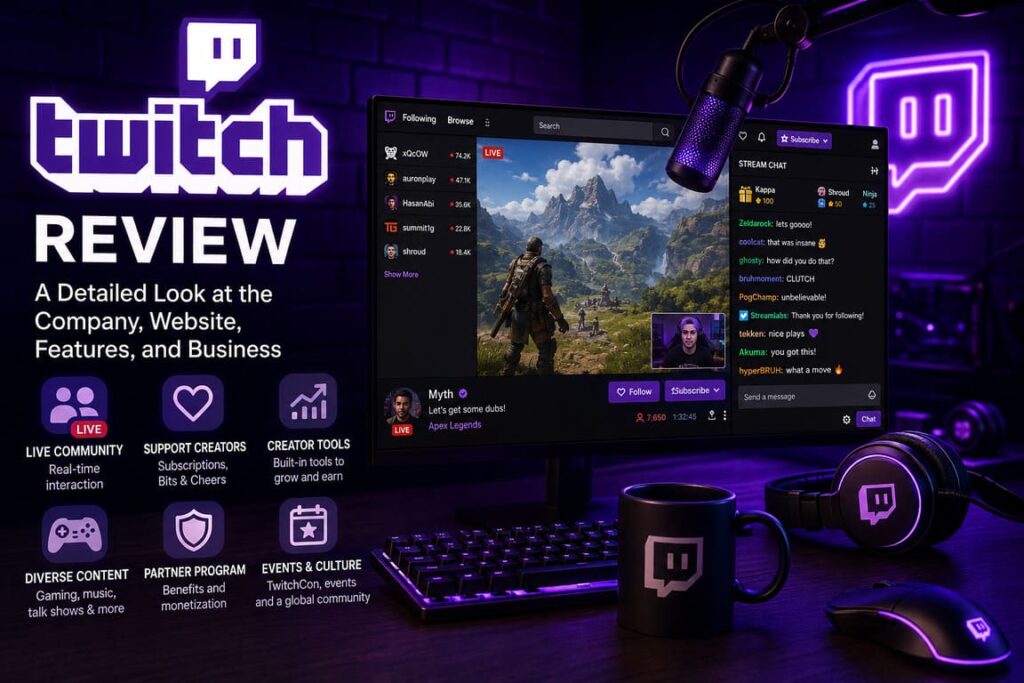

Twitch is a live-streaming platform built around real-time interaction. It started with gaming, but today it covers much more than that, including music, sports, talk shows, food, travel, and its huge “Just Chatting” category. Twitch describes itself as a place where millions of people come together live every day to chat, interact, and create entertainment together. That simple idea explains why the platform still matters: it is less about polished video uploads and more about live community.
What makes Twitch different from many other platforms is the role of chat. On Twitch, the audience is not just watching. People react live, joke with each other, support streamers, and help shape the stream itself. This real-time back-and-forth is the core product. In practice, Twitch feels more like a digital hangout than a normal video website.
About Twitch as a Company
Twitch is not a small startup anymore. It grew out of Justin.tv, and Reuters reported that Justin.tv became Twitch in 2011. The platform quickly gained traction in the gaming world because viewers could watch live play and message streamers and each other during the stream. That mix of live video and live chat became Twitch’s signature formula.
Three years later, Twitch was acquired by Amazon for just under $1 billion. Reuters separately reported the acquisition value at about $970 million in cash, which shows how important live streaming had already become by 2014. Today, Twitch operates as part of Amazon’s broader business. Search results from Twitch’s own legal notice state that Twitch Interactive, Inc. and its affiliates are subsidiaries of Amazon.com, Inc.
Twitch also has a clear company message. Its company page says it is “building the future of live, interactive entertainment one community at a time.” That line is not just branding. It reflects how Twitch sees itself: not only as a video platform, but as an infrastructure layer for creators, fans, advertisers, and developers who want live interaction instead of passive viewing.
Twitch at a Glance
| Category | Details |
|---|---|
| Website | Twitch.tv |
| Main focus | Live streaming and live community interaction |
| Origin | Grew out of Justin.tv |
| Twitch launch | 2011 |
| Parent company | Amazon |
| Acquisition | Acquired by Amazon in 2014 for about $970 million / just under $1 billion |
| Main content areas | Gaming, music, sports, talk shows, Just Chatting, food, travel, special events |
| Revenue model | Ads, subscriptions, Bits, creator tools, partnerships |
| Core strength | Live chat-driven community engagement |
Table 1. Core facts about Twitch and the business behind it.
What Twitch Does Well
Twitch is excellent at building communities around personalities and interests. A streamer does not need Hollywood-level production to succeed. Many of the best channels grow because the host is consistent, funny, skilled, or simply good at making viewers feel included. That gives Twitch a more personal feel than many large social platforms.
Another strength is category breadth. Twitch is still strongly linked to gaming, but the official About page highlights music, talk shows, sports, travel and outdoors, food and drink, and special events. That matters because it shows Twitch is no longer just for esports and gameplay. It now competes in a wider live-entertainment space.
Twitch also has a deep creator economy. Its Partner Program shows how serious the platform is about helping creators turn streaming into a business. Twitch Partners can earn through channel subscriptions, Bits, and ads. They also get tools such as longer VOD storage, better support, custom badges and emotes, guaranteed transcodes, and more channel control. These are not small perks. They are the tools that make streaming more stable and professional.
The blog also shows that Twitch is still investing in monetization. Recent posts focus on helping more streamers earn money, community participation tools, events, brand campaigns, and TwitchCon. That signals a platform that is still trying to support both top creators and smaller streamers who want to grow.
The Main Downsides of Twitch
Twitch is powerful, but it is not easy for everyone. For viewers, the site can feel noisy, especially if you do not already follow streamers or communities. For creators, growth is hard. The barrier to starting is low, but the barrier to earning real money is much higher. Live streaming is time-intensive, and success usually depends on consistency, personality, timing, and luck.
The company side also has pressure points. Reuters reported in early 2024 that Twitch was set to cut 35% of its workforce, or about 500 workers, and that the business remained unprofitable nine years after Amazon bought it. Reuters also noted earlier layoffs and the shutdown of Twitch operations in South Korea due to high operating costs and network fees. These are important facts because they show Twitch is culturally influential, but not a simple business success story.
Twitch has also faced creator frustration over revenue sharing and policy changes. Reuters reported that some top streamers criticized changes that affected how much subscription revenue they could keep, although Twitch later adjusted the policy. This tension is normal for creator platforms, but it matters because Twitch depends on keeping both creators and viewers loyal at the same time.
Key Twitch Features That Matter Most
- Live chat that turns passive viewers into active participants.
- Category variety beyond gaming, including music, sports, food, travel, and talk content.
- Subscriptions that let fans support creators directly.
- Bits and Cheers that create micro-support inside chat.
- Advertising tools for monetization and brand reach.
- Developer tools and extensions for custom community experiences.
- Events and creator culture, including TwitchCon and sponsored activations.
Interesting Facts About Twitch
One of the most interesting facts about Twitch is that it came from a project that was not originally about gaming at all. In a 2023 Twitch blog post, co-founder Emmett Shear explained that the team began in 2006 with a 24/7 live reality show about Justin Kan’s life. That experiment eventually turned into Justin.tv, then Twitch, and later an Amazon-owned company. It is a good example of a strange internet idea becoming a giant platform through a smart pivot. Source
Another interesting fact is scale on the creator side. In that same blog post, Shear said Twitch had grown to more than 8 million streamers a month. That does not mean 8 million stars, of course, but it does show how large the creator base became over time. Few platforms have that many people trying to build live communities at once.
A third interesting point is how Twitch blends entertainment and software. The official site calls Twitch “a developers dreamland” and highlights the need for custom tools built for different communities. That is unusual. Many media platforms talk about creators and audiences, but Twitch also openly pitches itself as a place for developers to build interactive tools.
Review Summary of Twitch
| Area | Strengths | Weaknesses |
|---|---|---|
| Viewer experience | Real-time chat, strong community feeling, live energy | Can feel chaotic or overwhelming |
| Creator opportunity | Strong monetization tools, loyal communities, brand potential | Hard to grow, high time commitment |
| Content variety | Far beyond gaming now | Gaming identity still dominates public perception |
| Business model | Multiple revenue streams from ads, subs, Bits | Profitability challenges and layoffs |
| Brand value | Deep engagement and active fandoms | Not every brand fits Twitch culture |
| Platform identity | Highly interactive and community-first | Policy and payout changes can create backlash |
Final Verdict on Twitch
Twitch is still one of the most important live platforms on the internet. It is not the cleanest website, the easiest place to grow, or the most stable business story. But as a live community product, it remains very strong. If you want interaction, shared moments, fandom energy, and creator-led entertainment, Twitch still does that better than most competitors.
From a company perspective, Twitch is a major internet brand with real cultural influence, a strong creator ecosystem, and clear strategic value to Amazon. At the same time, the business has shown signs of pressure through layoffs, cost issues, and monetization debates. So the honest review is this: Twitch is excellent as a live community platform, but more complicated as a business. That mix of cultural power and business friction is what makes it both impressive and fascinating.
FAQ About Twitch
Is Twitch only for gaming?
No. Twitch still has strong gaming roots, but its official categories also include music, sports, talk shows, travel, food and drink, and more.
Who owns Twitch?
Twitch is owned by Amazon. Reuters reported that Amazon acquired Twitch in 2014 for just under $1 billion.
How do streamers make money on Twitch?
Twitch streamers can earn through subscriptions, Bits, ads, and other creator programs. The Partner Program outlines these as core monetization features.
Is Twitch easy for beginners?
It is easy to start watching, but harder to master. For creators especially, building a channel takes time, consistency, and community skill.
What is the biggest strength of Twitch?
Its biggest strength is live interaction. The chat, community feel, and creator-viewer connection are the heart of the platform.
What is the biggest weakness of Twitch?
The biggest weakness is that it is difficult to turn into a stable business for everyone involved. Creators face growth challenges, and the company itself has dealt with profitability pressure and layoffs.